
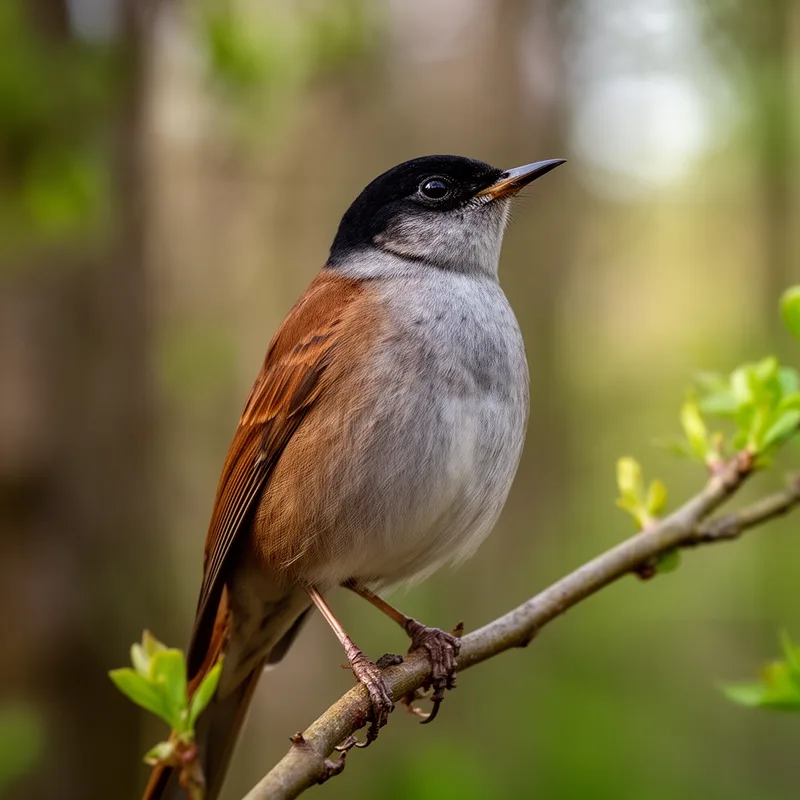
Sylvia atricapilla
- noun
- Specialized
- Unlike other warblers, the male Sylvia atricapilla sports a striking black crown on its head.
Examples
-
The distinctive song of the Sylvia atricapilla can be heard throughout European woodlands in spring.
-
Many birdwatchers are excited to spot a Sylvia atricapilla during their early morning walks.
-
The Sylvia atricapilla is often found in gardens.
-
Did you spot a Sylvia atricapilla in the park?
-
Many birdwatchers are excited to spot a Sylvia atricapilla during their early morning walks.
-
The distinctive song of the Sylvia atricapilla can be heard throughout European woodlands in spring.
-
Unlike other warblers, the male Sylvia atricapilla sports a striking black crown on its head.
Synonyms

A small bird that sings and has a black head, often found in gardens and woods
Surface Forms
Morphology
Sylvia + atricapilla
This is a Latin scientific binomial (a proper name) whose components are not English lexical items for a B1 learner, so knowing the constituent forms in English would not allow derivation of the meaning 'blackcap' or 'a small warbler'. Binomial names function as labels rather than compositional phrases in English, so the bird's meaning is not predictable from the parts and would be opaque to learners.
Etymology
Sylvia atricapilla comes from old Latin words: Sylvia from 'silva' meaning 'wood' or 'forest', and atricapilla from 'ater' ('black') + 'capillus' ('hair' or 'cap'). So, the name gives a simple picture — a small forest bird with a dark 'cap' on its head, which is why we call it the 'blackcap'.

