
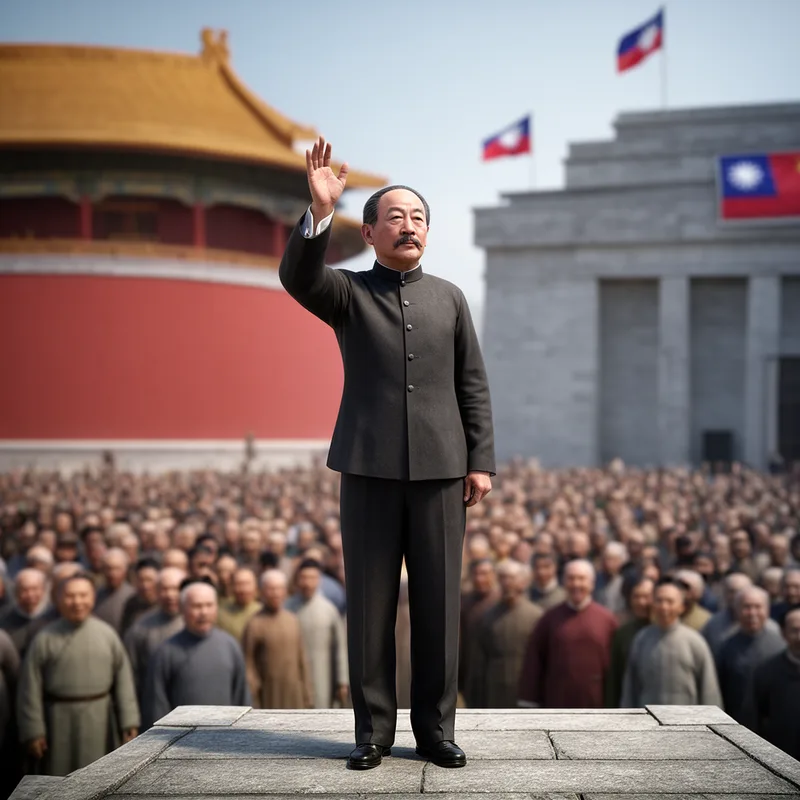
Sun Yat-sen
 1
8.4

- proper noun
- Sun Yat-sen is often called the 'Father of Modern China' for his role in establishing the republic.
Examples
-
Sun Yat-sen is often referred to as the 'Father of Modern China.'
-
The mausoleum of Sun Yat-sen in Nanjing is a popular historical site.
-
During his studies in Hong Kong, Sun Yat-sen developed his revolutionary ideas.
-
The legacy of Sun Yat-sen continues to influence Chinese politics today.
-
Sun Yat-sen is often called the 'Father of Modern China' for his role in establishing the republic.
-
During his studies in Hong Kong, Sun Yat-sen developed his revolutionary ideas.
-
The mausoleum of Sun Yat-sen in Nanjing is a popular historical site.
Synonyms
A Chinese leader who founded the Nationalist Party and became the first president of the Republic of China
Surface Forms
Morphology
Sun + Yat-sen
This is a proper name referring to a specific historical person, so its meaning (a Chinese statesman and revolutionary) is referential rather than compositional; the constituent parts 'Sun' and 'Yat-sen' do not combine to produce that meaning. Even if a learner knows 'sun' as the celestial body, that knowledge does not indicate the individual's identity or biography, so a B1 learner cannot derive the MWE's meaning from the parts.
Etymology
Sun Yat-sen is the Western spelling of a Chinese leader who helped end the old empire and start a republic. Think of his family name Sun like the sun rising — he helped bring a new 'day' to China, which is why people call him the 'Father of Modern China'.