

Struthio camelus
- noun
- Specialized
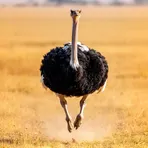
- The Struthio camelus, known for its long legs, is the largest living bird in the world.
Examples
-
The Struthio camelus can run at speeds up to 45 miles per hour.
-
Unlike most birds, Struthio camelus has only two toes on each foot.
-
The Struthio camelus is widely farmed for its meat, feathers, and leather.
-
Wild Struthio camelus populations roam the grasslands and savannahs of Africa.
-
Did you know that the Struthio camelus is native to Africa?
-
A group of Struthio camelus can often be seen grazing together on the African plains.
-
The Struthio camelus can reach impressive speeds, making it one of the fastest birds on land.
Synonyms
 24
1.3
24
1.3

A very large African bird that cannot fly and runs very fast
Surface Forms
Morphology
Struthio + camelus
This is a Latin taxonomic binomial (a scientific name) functioning as a proper noun rather than a compositional English phrase, so its referent 'the ostrich' is an arbitrary label rather than predictably derivable from the parts. One constituent ('camelus') has no clear dictionary gloss here and even knowing 'Struthio' as a genus label only signals a bird group; overall a B1 learner knowing the parts would not reliably infer the common English meaning.
Etymology
Struthio camelus may come from older words: Struthio was a word for a small bird like a 'sparrow' and camelus means 'camel', because people thought the bird's long neck and big body were a bit like a camel. So the name helps you remember this is the large, long-necked African bird we call the 'ostrich'.