
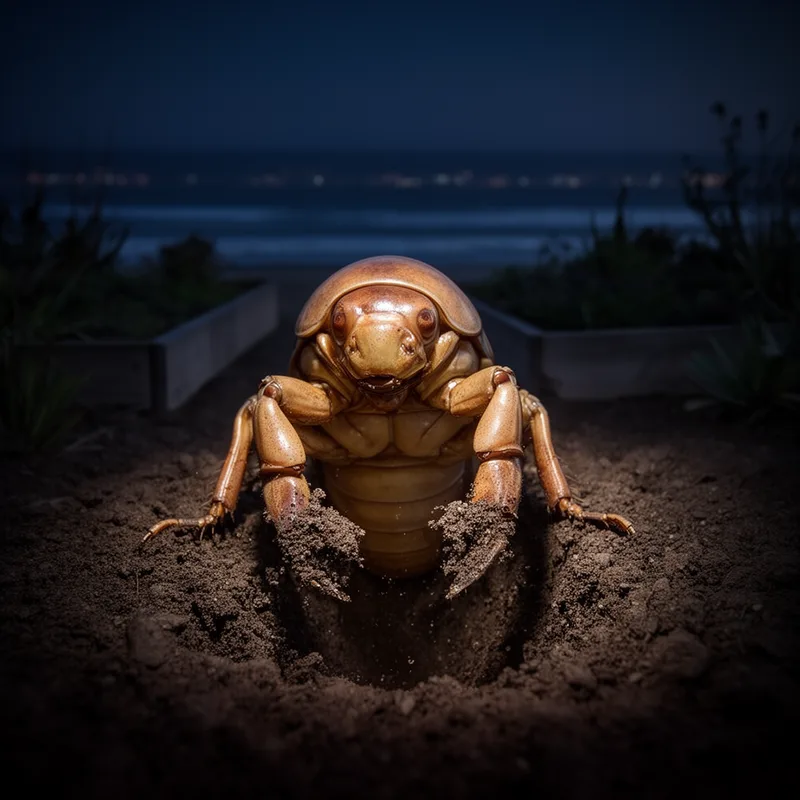
Stenopelmatus fuscus
- noun
- Specialized
- Unlike other crickets, the Stenopelmatus fuscus does not chirp and can sometimes startle gardeners with its large size.
Examples
-
The Stenopelmatus fuscus is often spotted at night in California gardens, burrowing in loose soil.
-
Researchers studying soil health frequently encounter Stenopelmatus fuscus during nocturnal field surveys near the Pacific coast.
-
The Stenopelmatus fuscus is often found in sandy soil.
-
Have you ever seen a Stenopelmatus fuscus in the wild?
-
While exploring the dunes, we spotted a Stenopelmatus fuscus burrowing into the sand during the evening.
-
The large, wingless Stenopelmatus fuscus is an intriguing insect that prefers dark, moist environments along the Pacific coast.
-
During our night hike, we encountered a Stenopelmatus fuscus emerging from its burrow near a rocky outcrop.
Synonyms

A large, wingless insect active at night that lives in loose soil and burrows
A large wingless grasshopper that digs holes in loose sand at night
Surface Forms
Morphology
Stenopelmatus + fuscus
This is a Linnaean binomial (genus + species): knowing 'Stenopelmatus' as a genus of sand crickets lets a learner infer the phrase names a particular kind of that insect, so the taxonomic composition is partly transparent. However the species epithet 'fuscus' is a Latin form not given in the learner dictionary and requires specialized/Latin knowledge to interpret (it commonly means 'dark'), so the exact meaning is not fully derivable by an average B1 learner.
Etymology
Stenopelmatus fuscus may come from old Greek and Latin words: steno- meaning 'narrow' and fuscus meaning 'dark'. The image is of a large, dark cricket with narrow feet that burrows in soil at night, so the name helps you picture and remember this insect today.

