
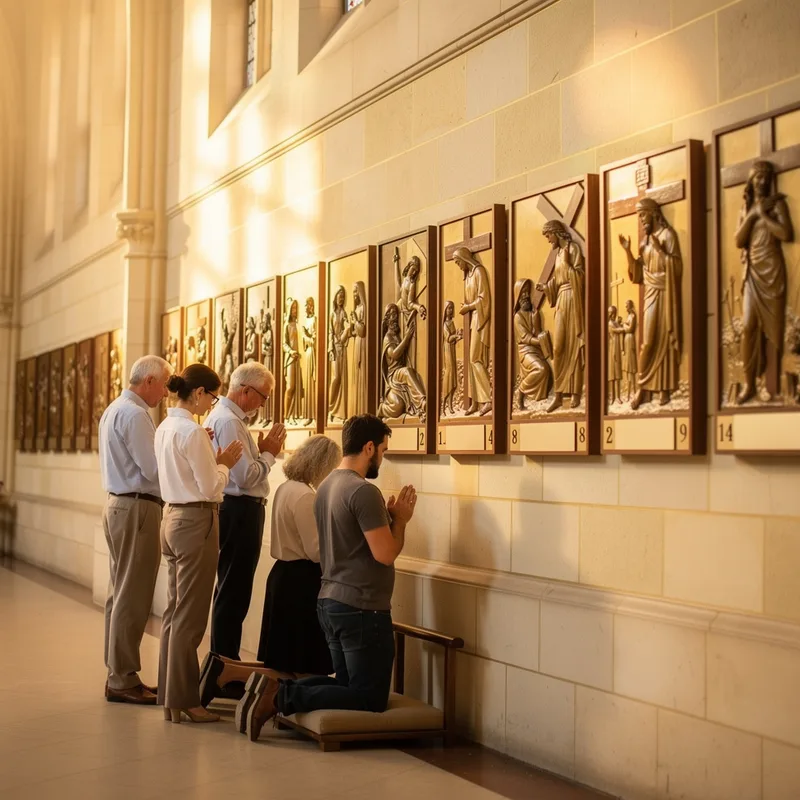
Stations of the Cross
 1
9.9
1
9.9

- noun
- Continue past the bronze statue of the angel to the paved road that is flanked by the fourteen Stations of the Cross.
- Stations of the Cross during Lent
- the fourteen Stations of the Cross
Examples
-
During Holy Week, the community participates in the Stations of the Cross to honor the sacrifices made by Jesus before his crucifixion.
-
She wondered if her mother would bring her to Mass or to the Stations of the Cross during Lent.
Fiction book (1994) -
After the Stations of the Cross, the celebrants sat in clusters on the grass, waiting for lunch to be served by the host community.
Academic text (2001) -
After a ceremony inside the chapel, the celebrants walked outside in a procession reenacting the Stations of the Cross.
Academic text (2001) -
To return to the structure of the Church of the Immaculate Conception, as we look around its walls, we see what is perhaps its most well-known feature: the Stations of the Cross painted by Anishnaabe artist Leland Bell.
Academic text (1996) -
Every year during Lent, our church holds special services focused on the Stations of the Cross to reflect on Jesus' journey to crucifixion.
-
We gathered in the chapel to pray and meditate on the Stations of the Cross, recalling each significant event of Jesus' suffering.
Synonyms

Fourteen images showing Jesus' path to his death on a cross that people pray and think about

A set of pictures or stations in a church that show Jesus's path to the cross
Surface Forms
Morphology
The constituents 'stations' (stops/places) and 'cross' (the crucifix or crucifixion) give a general, compositional idea of places or stops related to the crucifixion, so a learner could infer something like a sequence of locations or events. However, the full meaning — a specific Catholic devotion of fourteen prayers/meditations typically depicted by images — is culturally specific and not fully derivable from the words alone, so prior exposure is needed for complete understanding.
Etymology
The church practice Stations of the Cross comes from moving from one picture or carving to another, pausing at each station to remember an event on Jesus' walk to the cross. So the phrase means the set of images and short prayers used to remember Jesus' suffering.