

St. Petersburg
 5
2.7
5
2.7

- proper noun
- /seɪnt ˈpɜrtɪsbɜrg/
- My friend just returned from a trip to St. Petersburg, where he explored the city's rich history.
- St. Petersburg, Russia
- St. Petersburg Times
- St. Petersburg Olympiad
Examples
-
After the honeymoon, the Kallases moved to St. Petersburg, where Oskar taught and led a very modest life.
Academic text (1999) -
I am planning to visit St. Petersburg to see its famous canals and architecture.
-
If I send a plane, will you come to St. Petersburg?
-
I have a situation in St. Petersburg.
-
I'm flying back to St. Petersburg tomorrow.
-
After the ceremony, we left for St. Petersburg where we will spend our honeymoon.
-
I didn't know you were going back to St. Petersburg so soon.
-
He moved to St. Petersburg.
-
I've been in St. Petersburg for the christening of a granddaughter.
-
Yes, I was head of obstetrics research at Pasklovansky Hospital in Leningrad, now St. Petersburg.
Synonyms
 1
2.9
1
2.9
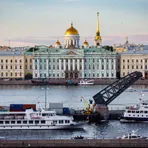
A large port city in northwestern Russia that was once the capital and is the country's second largest

A large city in northwest Russia that used to be the capital
Surface Forms
Morphology
St. + Petersburg
The form is clearly compositional (Saint + Petersburg), so a learner who knows the constituents can infer this is a place name—likely a town or city named after Saint Peter. However, the specific encyclopedic facts in the definition (that it is the second largest city in Russia, its location, and former capital status) are not derivable from the words alone, so full meaning requires world knowledge.
Etymology
St. Petersburg in Russia was started by the ruler Peter the Great and named after Saint Peter, so St. means 'Saint' and Petersburg means 'Peter's town'. That's why the name honors Peter and explains why the city became his new capital.