
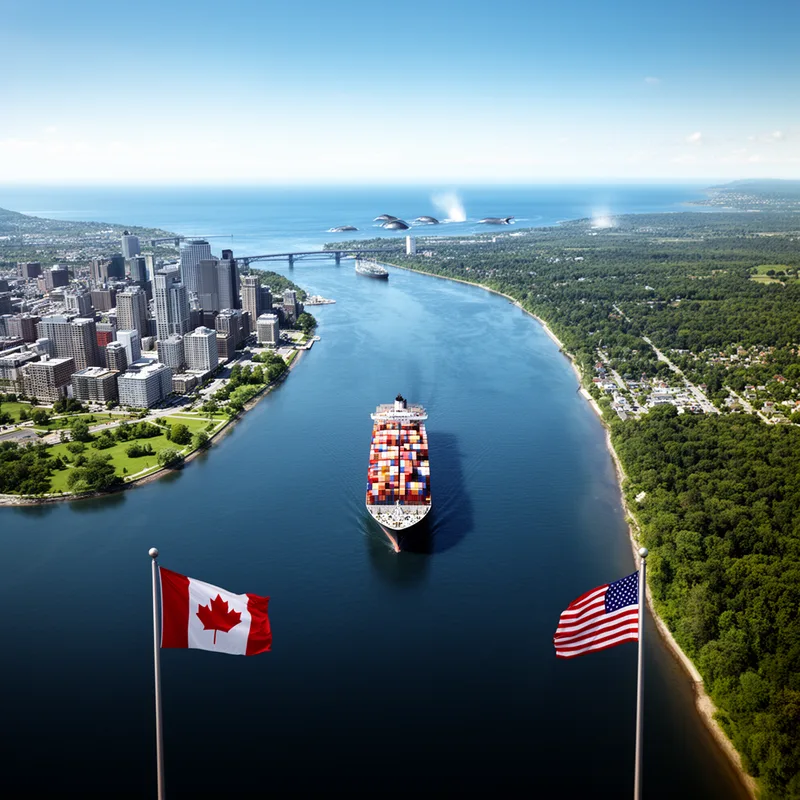
St. Lawrence
- proper noun
- /seɪnt ˈlɔːrəns/
- Similarly, a second study of 112 male St. Lawrence River fish consumers found no association between fish intake and serum omega-3 fatty acids (Godin et al. 2003).
- St. Lawrence River
- fish from the St. Lawrence
Examples
-
By early November, just 600 men had reached the St. Lawrence, leaving behind their sick and starving.
-
We have included data on fish from the five Great Lakes, mouths of rivers feeding into the Great Lakes, and the St. Lawrence River.
Academic text (2012) -
What little information has been published on the omega-3 fatty-acid content of even a limited number of fish species from Lake Superior, Lake Michigan, and the St. Lawrence River is over 10 years old.
Academic text (2012) -
The small border town of Massena, New York, near the St. Lawrence River, promised to anchor a third production hub specializing in electrometallurgical manufacture, but for its reliance on imported power.
Academic text (2004) -
The St. Lawrence River was first explored by Jacques Cartier in the mid-sixteenth century, but it was only in 1608 that Samuel de Champlain founded Quebec City.
Academic text (2004) -
The two most significant French settlements, Quebec and Montreal, both lay along the St. Lawrence River.
-
When fishing clear water, such as the St. Lawrence, try using surface lures, even in water as deep as 20 feet.
Synonyms


 1
2.8
1
2.8
A large river in North America that flows from the Great Lakes to the North Atlantic
 1
2.8
1
2.8
A large river in eastern North America that flows northeast from Lake Ontario into the Gulf of Saint Lawrence

A large river in eastern North America that flows from Lake Ontario to the Atlantic
Surface Forms
Morphology
St. + Lawrence
The components 'St.' (Saint) and 'Lawrence' are a title and a proper name, so knowing them does not allow a learner to infer that this refers to a major river or its geographic role; place names are referentially arbitrary rather than compositionally descriptive. Although many languages use 'Saint + name' for places, that pattern does not make the specific meaning 'a major river' predictable to a B1 learner who only knows the constituents.
Etymology
St. Lawrence (the river) got its name from early European explorers who reached it on the saint's 'feast day', so they named the great river and the gulf after St. Lawrence, and the name has stuck as the main water route between the Great Lakes and the Atlantic.