
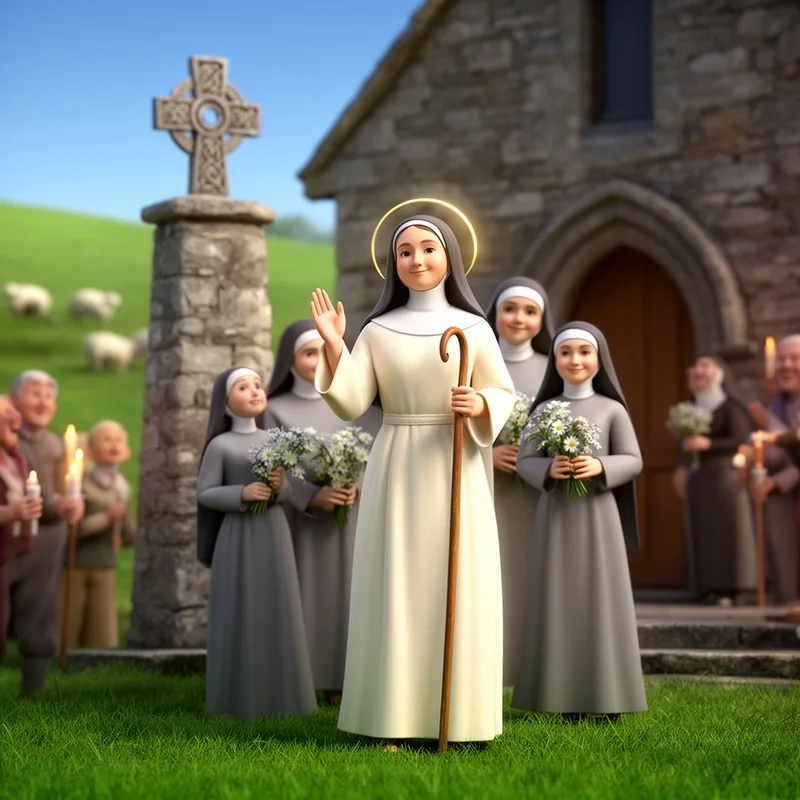
St. Bride
- proper noun
- Did you know that St. Bride is also known as Saint Brigid?
Examples
-
The feast of St. Bride is celebrated on February 1st in Ireland.
-
Many churches in Scotland and England are dedicated to St. Bride.
-
Legends say that St. Bride was renowned for her generosity and miracles.
-
Many people visit St. Bride every year.
-
According to tradition, St. Bride performed many miracles during her life.
-
Every year, thousands of pilgrims gather to celebrate the legacy of St. Bride.
-
In Irish history, St. Bride is celebrated as a symbol of charity and compassion.
Synonyms

 1
9.7

An Irish woman who led a religious community and became a patron saint of Ireland


 1
8.2
An Irish saint who started and led a monastery and cared for poor people
 1
7.0
A leader of nuns in Ireland and a saint known for prayer and helping the poor
 1
8.7
A famous Irish nun who founded convents and is a patron saint of Ireland
 1
8.7
An Irish nun who is a patron saint of Ireland remembered for her holy life

An Irish nun known as Saint Brigid, honoured as the patron saint of Ireland and celebrated on February 1

A leading Irish nun and patron saint who lived in the fifth and sixth centuries
Surface Forms
Morphology
St. + Bride
A B1 learner who knows 'St.' as the abbreviation for 'Saint' and the word 'bride' will likely recognize 'St. Bride' as the name of a saint (i.e. a proper name), so the general category (a saint) is derivable. However, the specific historical identity and cultural details (that this refers to Saint Brigid of Kildare, an Irish abbess) are not predictable from the constituents alone, and the capitalized form/name mapping may be unfamiliar, so full meaning is not transparently available.
Etymology
St. Bride comes from an Irish saint, Saint Brigid of Kildare, who lived long ago and was famous for helping the poor and for stories of small miracles she did. That's why many churches are named for her and today St. Bride refers to that kind, protective saint.