

St. Andrew
- proper noun
- According to tradition, St. Andrew was martyred by crucifixion on an X-shaped cross.
Examples
-
Many Scots wear a flag with the symbol of St. Andrew to celebrate their national holiday.
-
On his feast day, people honor St. Andrew with various celebrations and church services.
-
Joseph, I want you to start praying to St. Andrew the minute I leave.
Synonyms

 859
2.8
859
2.8

A person who is one of the twelve disciples of Jesus, brother of Peter, and patron saint of Scotland
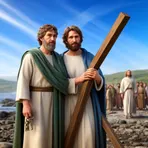
One of the twelve followers of Jesus, brother of Peter and patron saint of Scotland

A follower of Jesus who was Peter's brother and is the patron saint of Scotland
Surface Forms
Morphology
St. + Andrew
The expression combines the abbreviation 'St.' (saint) with the proper name 'Andrew', so a learner who knows both constituents can infer it refers to Saint Andrew (the disciple/patron saint). This is a straightforward compositional proper-name construction and parallels naming patterns in many languages, making the meaning immediately derivable from the parts.
Etymology
St. Andrew comes from Andrew, one of Jesus's twelve followers who, in old stories, was killed on an X-shaped cross. One popular story says some of his bones were brought to what is now Scotland and the X-shaped cross became Scotland's flag, so St. Andrew became the country's 'patron saint' and his name is used for towns, churches, and a national holiday.