
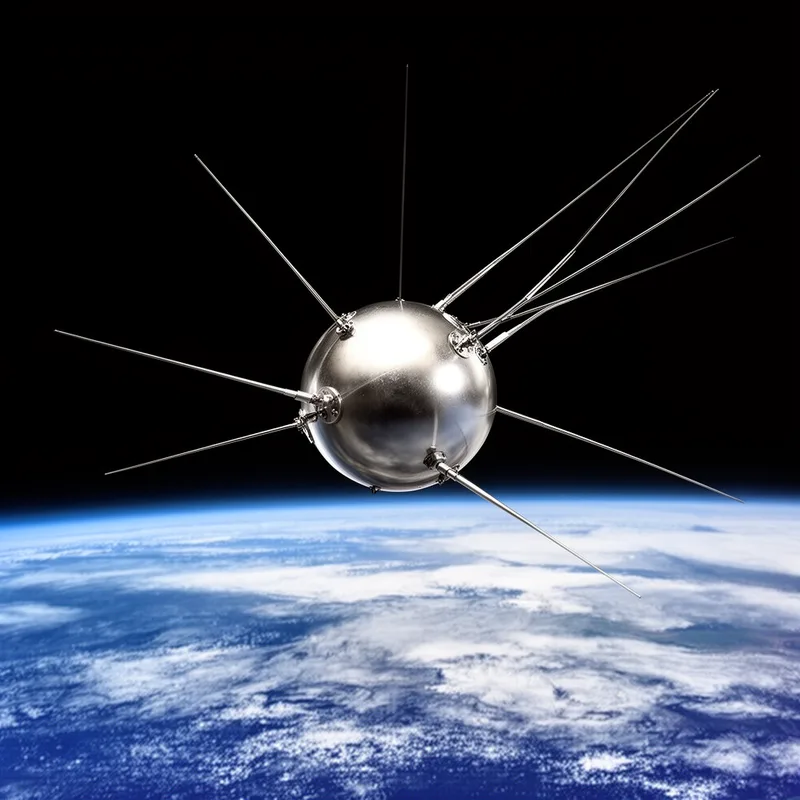
Sputnik
 1
6.4

- proper noun
- /ˈspʌtnɪk/
- In 1957, the Soviet Union opened the final frontier by sending the Sputnik satellite into orbit.
- Sputnik launch
- Soviet Sputnik
- Sputnik era
Loading YouTube…
Watch on YouTubeThis is a pre Sputnik picture of me with my my telescope.
- This is a pre Sputnik picture of me with my my telescope.
- So Sputnik starts this whole, you know, notion of the science gap.
- And part of it is because of Sputnik, you know, and, and the, the Cold War.
Examples
-
Decades ago, in the post-Sputnik era, school reforms addressed teaching and learning in each curriculum strand.
Academic text (1991) -
On 4 October 1957, the Soviets launched Sputnik I, making the USSR the first nation in space.
Academic text (1997) -
So it was started after Sputnik, and all it does is fun, cool stuff, basically.
-
Now who can tell me why Sputnik is so important?
-
We responded similarly during the early days of Sputnik and the space race.
Academic text (1997) -
Back in the days of Sputnik, the economy and the world of work were simpler.
Academic text (1995) -
Half a century ago, the launch of Sputnik precipitated major educational reform across all of education.
Academic text (2008) -
In October 1957, the Soviet Union launched the world's first artificial satellite, Sputnik 1, into orbit.
-
In 1957, the Union of Soviet Socialist Republics launched Sputnik, inadvertently advancing the development of professional school counseling.
Academic text (2004) -
On October 4, 1957, the Soviet Union successfully launched Sputnik, the first artificial satellite to orbit the Earth.
Surface Forms
Etymology
Sputnik comes from a Russian word that literally means 'fellow traveller' — from s- 'with' and putnik 'traveller' — so the satellite series was named as a set of 'companions' travelling with the Earth.