
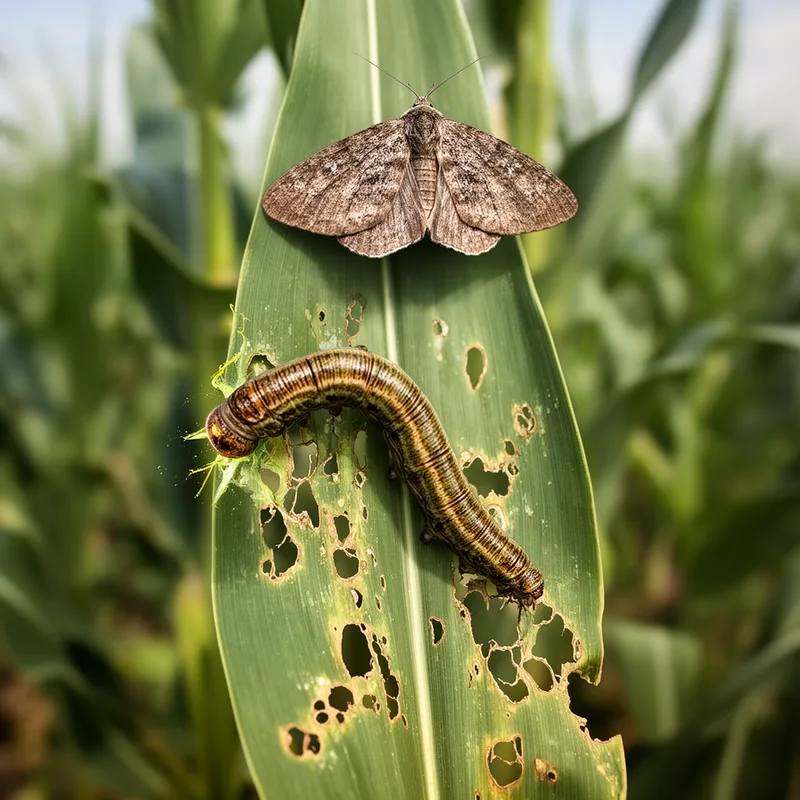
Spodoptera frugiperda
- noun
- /spəˈdɒptərə fruːdʒɪˈpɛrdə/
- Specialized
- Farmers are concerned about Spodoptera frugiperda damaging their maize crops.
Examples
-
The larva of Spodoptera frugiperda is known for devastating cereal crops across the Americas and Africa.
-
Research on controlling Spodoptera frugiperda is crucial for global food security.
-
Farmers in many countries worry about the rapid spread of Spodoptera frugiperda in their maize fields.
-
The Spodoptera frugiperda larvae can devastate fields in just a few days.
-
Farmers in many countries worry about the rapid spread of Spodoptera frugiperda in their maize fields.
-
Research on controlling Spodoptera frugiperda is crucial for global food security.
-
The larva of Spodoptera frugiperda is known for devastating cereal crops across the Americas and Africa.
Surface Forms
Morphology
Spodoptera + frugiperda
This is a Latin binomial (genus + species) so a learner who knows 'Spodoptera' as a moth genus can infer it names a species of that genus, making the taxonomic relation partially compositional. However, the species epithet 'frugiperda' and the specific meaning 'fall armyworm / major crop pest' are not predictable for a B1 learner (and the epithet is not glossed), so the full referential meaning is not transparently derivable.
Etymology
Spodoptera frugiperda comes from old Greek and Latin words: Spodoptera combines words for 'ash' and 'wing', and frugiperda means 'fruit-destroyer'. So the name gives a clear image of a grey-winged moth whose young eat and ruin crops, which is why it is the name of a major crop pest.

