
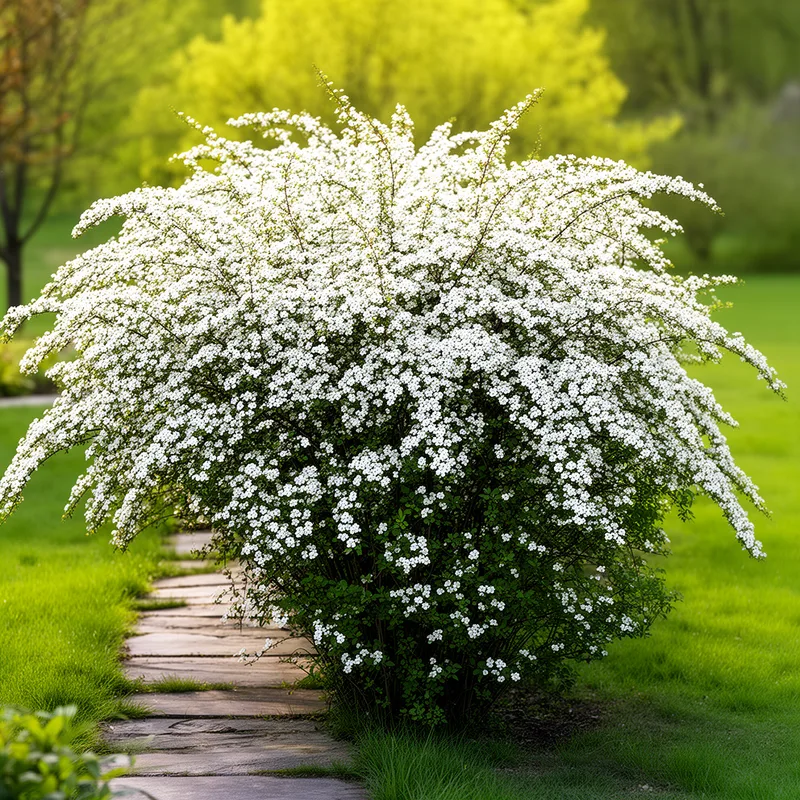
Spiraea prunifolia
- noun
- Specialized
- In early spring, the Spiraea prunifolia bursts into a profusion of delicate white blossoms.
Examples
-
Gardeners prize Spiraea prunifolia for its graceful, arching branches and showy spring flowers.
-
The Spiraea prunifolia hedge created a lovely border along the walkway.
-
Look at that Spiraea prunifolia!
-
The Spiraea prunifolia blooms beautifully in spring.
-
In spring, the garden was filled with blooming Spiraea prunifolia, showcasing its delicate white flowers.
-
Many homeowners choose Spiraea prunifolia for landscaping due to its beautiful floral display in early spring.
-
The florist recommended Spiraea prunifolia for the wedding decorations because of its stunning white blossoms.
Synonyms

A shrub with curving branches and groups of small white flowers, often grown in gardens
A small bush with many white flowers that bloom in spring
Surface Forms
Morphology
Spiraea + prunifolia
The name is a botanical binomial combining the genus Spiraea (a shrub) with a Latin descriptive epithet; if a learner knew both constituents (and recognized Latin roots pruni-/‑folia as ‘plum‑/leaf’), they could infer it denotes a Spiraea species with a leaf trait. However, the epithet is Latin/technical and not standard English vocabulary, so the sense is only partially predictable to a typical B1 learner unfamiliar with botanical morphology.
Etymology
Spiraea prunifolia may come from the group name Spiraea, for shrubs with long, bending branches, and the Latin word prunifolia, meaning 'plum-like leaves'. In spring the shrub's long branches are covered with small white flowers that look like a 'bridal wreath', so gardeners call it 'bridal wreath spirea' today.

