

Spanish mackerel
- noun
- /ˈspænɪʃ ˈmækərəl/
- US
- Coastal migratory pelagic fish include king mackerel, Spanish mackerel, cero, little tunny, cobia, dolphin, and, in the Gulf of Mexico only, bluefish.
- Spanish mackerel and bluefish
- Spanish mackerel and pompano
- Spanish mackerel and trout
Examples
-
At times, two typically southern fishes, Atlantic croaker (Micropogonias undulatus) and Spanish mackerel (Scomberomorus maculatus), were abundant enough to be important in commercial catches.
Academic text (1990) -
Pasty and pukestained as they were, they trolled for kingfish and Spanish mackerel like their lives depended on it, and Carrie, too.
Fiction book (1990) -
Data on Spanish mackerel are known only from newspaper accounts (Red Bank Register, various articles); it was caught in commercial quantities in the 1880s and 1890s, but is scarce now.
Academic text (1990) -
Many people enjoy cooking Spanish mackerel because of its rich flavor.
-
During the summer, fishermen often catch Spanish mackerel near the shore.
-
The restaurant specializes in seafood, featuring Spanish mackerel on their menu.
Synonyms

 2
2.5
2
2.5

The flesh of a small oily sea fish eaten as food

A large spotted mackerel from the Atlantic coast of North America used for food
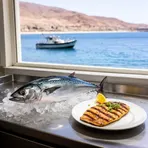
A sea fish like a mackerel found off western North America, eaten as food

A fish like a Spanish mackerel that lives along the Pacific coast of western North America

A type of sea fish like Spanish mackerel that people eat
Surface Forms
Morphology
This is a straightforward adjective + noun combination where 'Spanish' modifies 'mackerel', so a learner who knows both words will infer it denotes a kind or variety of mackerel associated with Spain (or a Spanish-type mackerel) and used as food. The compositional pattern is common cross-linguistically and does not require idiomatic knowledge, making the meaning directly derivable from the constituents.
Etymology
Spanish mackerel may get its name from old fishing days, because one popular story says Spanish fishermen or ships often caught or sold this shiny, fast fish and people began to call it Spanish mackerel. That's why the name now means a large coastal fish people eat as 'food'.