
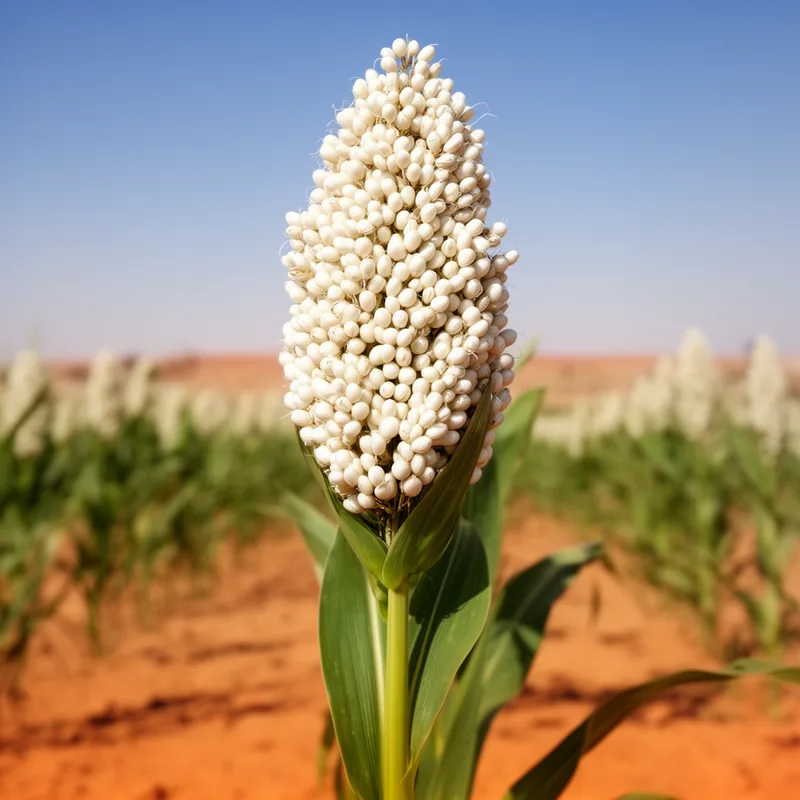
Sorghum vulgare caudatum
- noun
- Specialized
- The farmers chose to plant Sorghum vulgare caudatum because of its high grain yield and resilience.
Examples
-
The bread was made from flour milled from Sorghum vulgare caudatum grains.
-
Researchers are studying Sorghum vulgare caudatum for its potential in drought-prone areas.
-
The farmer planted Sorghum vulgare caudatum this season.
-
Have you ever tried Sorghum vulgare caudatum?
-
Researchers are studying Sorghum vulgare caudatum for its potential in drought-prone areas.
-
The bread was made from flour milled from Sorghum vulgare caudatum grains.
-
The farmers chose to plant Sorghum vulgare caudatum because of its high grain yield.
Synonyms

A type of sorghum with large soft white grains used to make porridge and bread
A plant from Sudan that makes large soft white grains
A type of sorghum with white seeds originally from Sudan
Surface Forms
Morphology
sorghum + vulgare + caudatum
This is a scientific Latin trinomial name: only 'sorghum' is an ordinary English noun; 'vulgare' and 'caudatum' are Latin-form elements not known to a typical B1 learner and are not listed in the provided dictionary entries. While a learner who knows 'sorghum' might guess it denotes a type/variety of that plant, the specific meaning (origin and grain characteristics) cannot be derived from the constituent forms, so the expression is not transparently interpretable.
Etymology
Sorghum vulgare caudatum comes from words that describe how the plant looks: Sorghum is the grain, vulgare means 'common', and caudatum means 'with a tail' because the plant's seed head often has a long, tail-like part. So the name points to this Sudan variety known for its very large, soft, white grains.

