
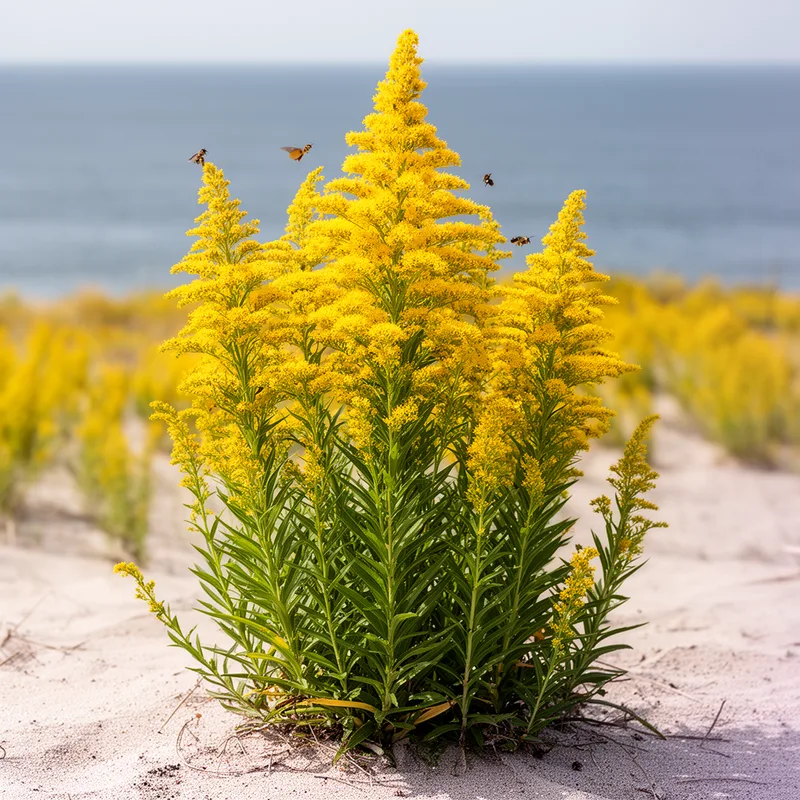
Solidago sempervirens
- noun
- Specialized
- The dunes were covered with Solidago sempervirens, its golden blossoms bright against the sandy soil.
Examples
-
Coastal restoration projects use Solidago sempervirens for its resilience to salt spray and wind.
-
Gardeners often plant Solidago sempervirens to attract pollinators near the coastline.
-
The Solidago sempervirens blooms beautifully in late summer.
-
I saw a field full of Solidago sempervirens last weekend.
-
Coastal restoration projects use Solidago sempervirens for its resilience to salt spray and wind.
-
Gardeners often plant Solidago sempervirens to attract pollinators near the coastline.
-
The dunes were covered with Solidago sempervirens, its golden blossoms bright against the sandy soil.
Synonyms



 1
8.9
1
8.9
A plant with bright yellow flowers that grows near the sea

A tall plant with bright yellow flowers that grows on sandy coasts
Surface Forms
Morphology
The Latin binomial is compositionally genus (Solidago) + specific epithet (sempervirens = ‘‘always green/evergreen’’), so a learner who knows both parts can infer this refers to a plant species that remains green. However, the specific information that it is a goldenrod with bright yellow flowers and a particular coastal distribution is not predictable from the constituents unless the learner already knows that Solidago = goldenrod, so the transparency is only partial.
Etymology
Solidago sempervirens is a Latin plant name that gives a clear picture: Solidago is a goldenrod and sempervirens means 'always green', so imagine bright yellow flowers that keep growing even in coastal wind and salt. That's why the name fits this hardy goldenrod often used on dunes and in coastal gardens to attract bees and butterflies.