
Sleeping Beauty
 6
3.5
6
3.5

- proper noun
- /ˈsliːpɪŋ ˈbjuːti/
- Literature
- The original Sleeping Beauty story was a 14th-century romance called Perceforest.
- Disney's Sleeping Beauty
- Aurora, the Sleeping Beauty
- Sleeping Beauty Castle
Loading YouTube…
Watch on YouTubeThis year's theme is Sleeping Beauty's reawakening fashion.
- This year's theme is Sleeping Beauty's reawakening fashion.
Examples
-
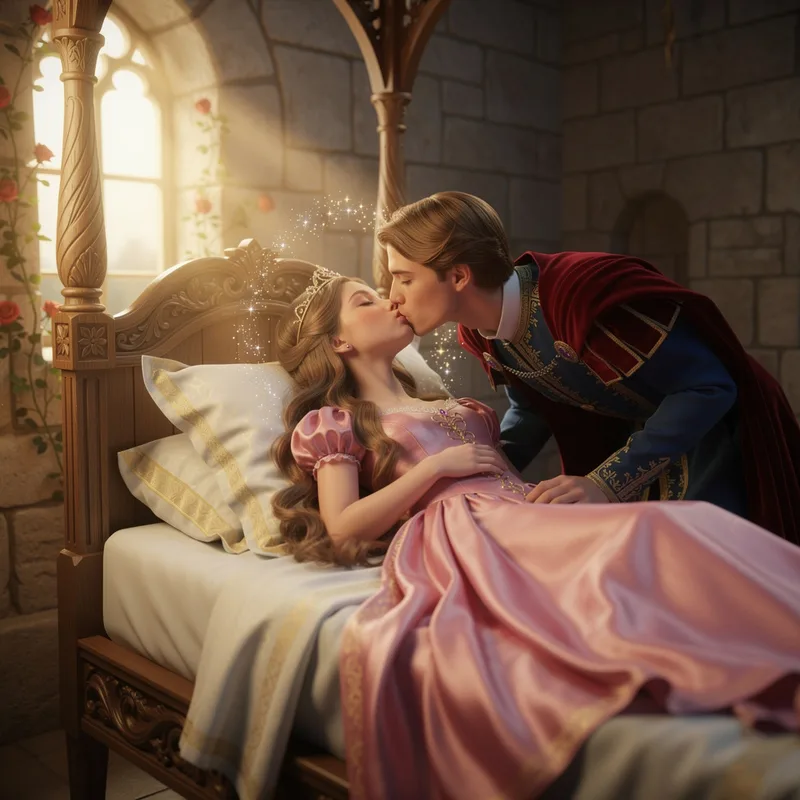
And then the prince kissed Sleeping Beauty.
-
Today, the Sleeping Beauty fairytale lives on.
Blog text (9) -
What really woke the princess Sleeping Beauty up?
-
Her favorite is probably Sleeping Beauty, which has some gorgeous artwork and music.
Blog text (3) -
Here comes Sleeping Beauty!
-
The most famous version (other than Disney's) of Sleeping Beauty is Charles Perrault's.
Blog text (8) -
Don't the fairy tales say it's "true love's" kiss that woke Sleeping Beauty?
Blog text (21) -
Sleeping Beauty awakes.
-
In the fairy tale, the prince wakes Sleeping Beauty with a kiss after she falls into a deep sleep.
-
The classic tale of Sleeping Beauty captivates audiences with its story of love and enchantment.
Surface Forms
Morphology
A learner who knows 'sleeping' and 'beauty' can readily infer the literal sense 'a beautiful person who is asleep', so the phrase is partially compositional. However, the conventionalized fairy-tale referent (the princess cursed into a prolonged sleep and awakened by a prince) and its extended figurative uses are cultural/lexical knowledge not predictable from the parts alone, so full interpretation requires prior exposure.
Etymology
Sleeping Beauty comes from an old fairy tale about a princess who falls into a 'deep sleep' after a curse and is woken by a prince's kiss. So the name refers to that famous story and its characters.