
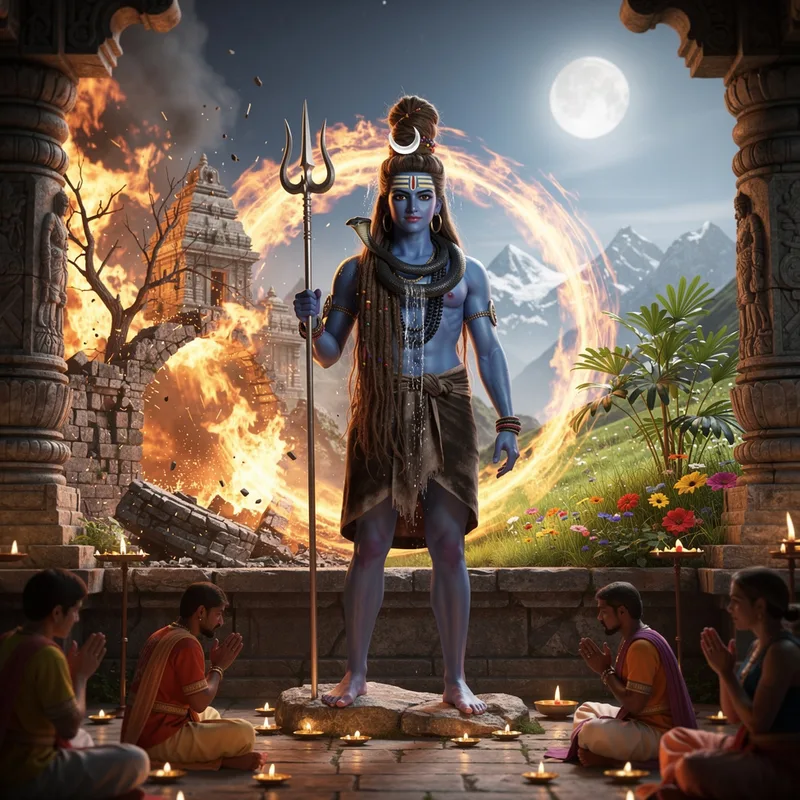
Siva
 1
7.9

- proper noun
- /ˈsiːvə/
- Here, Rama, an incarnation of Vishnu, is said to have worshiped Siva before his campaign against the demon king Ravana.
- worship of Siva
- Siva and Vishnu
Examples
-
Indeed, during the death meditation that Thompson vividly recounts (p. 279), the figure he saw was Siva, the lord of the dance.
Academic text (2016) -
His first long-distance spiritual pilgrimage with his guru to Varanasi, the primordial city of Siva, is especially significant.
Academic text (2001) -
lt is why Siva brought you here.
-
We prayed to Siva to help us find the stone.
-
Equivalent to Varanasi in the north, Ramesvaram is the premier place of Siva pilgrimage in the south.
Academic text (2001) -
Bhagavan Siva explained in great detail to Devi Parvathi the process of worship aimed at Him.
Blog text (14) -
He climbs Mount Kailasa to meet Siva, the Hindu god.
-
In the Hindu religion, Vishnu and Siva represent, respectively, the sustenance and dissolution aspects of existence.
Academic text (2001) -
A number of exquisite bronze statues have been recovered from shrines to the Hindu god Siva erected at Polonnaruva during the period of Cola domination.
Academic text (2002) -
In Hindu mythology, Siva is revered as 'the auspicious one', embodying the roles of both destroyer and restorer of worlds.
Synonyms
 13
7.7
A major Hindu god who destroys and changes the world
Surface Forms
Etymology
Siva comes from the old Sanskrit name Śiva, which means 'auspicious' or 'lucky', so a helpful way to remember him is as a power that clears away the old to make room for new life. That's why Siva is both the destroyer and the restorer of worlds.