
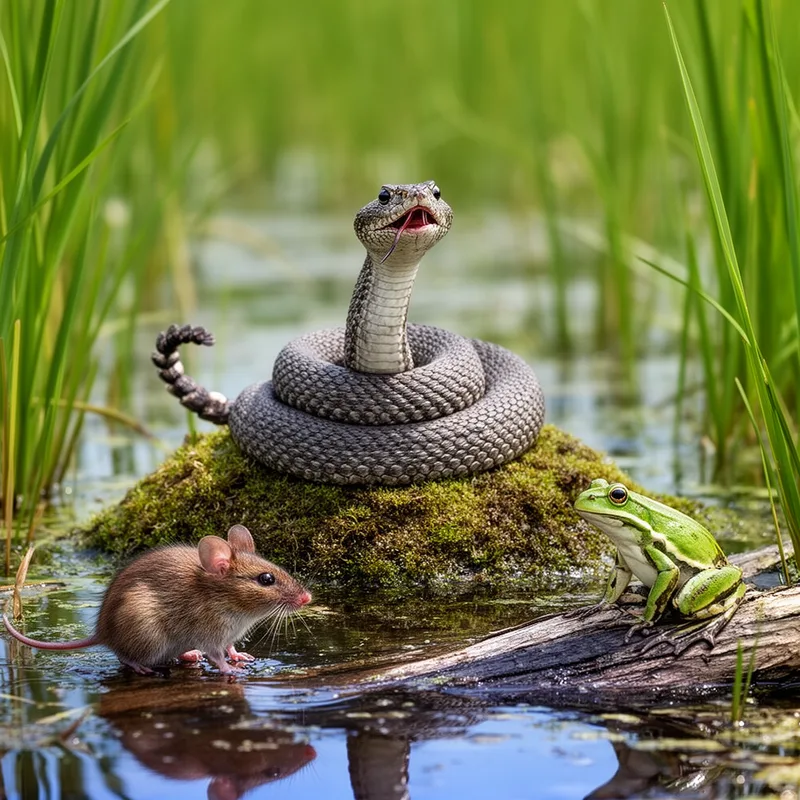
Sistrurus catenatus
- noun
- /ˈsɪstrʊrəs kætəˈneɪtəs/
- Specialized
- The Sistrurus catenatus is a small rattlesnake that thrives in wetlands and feeds on small amphibians.
Examples
-
The Sistrurus catenatus inhabits swamps and wet meadows across Central North America.
-
Wildlife researchers tracked Sistrurus catenatus populations to study their response to environmental changes.
-
Because Sistrurus catenatus is a venomous snake, it is important to observe it from a safe distance.
-
The Sistrurus catenatus is often found near wetlands.
-
Have you ever seen a Sistrurus catenatus in the wild?
-
In the Great Lakes region, the Sistrurus catenatus can often be spotted basking in the sun after a rain.
-
The diet of the Sistrurus catenatus mainly consists of mice and other small creatures found in its moist habitat.
Synonyms
A small venomous rattlesnake that lives in wet places in North America
A small venomous rattlesnake in North America, usually gray with dark bands
Surface Forms
Morphology
Sistrurus + catenatus
This is a Latin scientific binomial (a proper name) rather than a compositional English phrase; its descriptive meaning (a small rattlesnake found in wetlands) is not predictable from everyday English words. While 'Sistrurus' may hint at a rattlesnake genus, 'catenatus' is a Latin epithet (not a transparent English constituent), so a B1 learner knowing the parts would not reliably infer the full meaning.
Etymology
Sistrurus catenatus comes from old scientific words: Sistrurus may mean a 'rattle' and catenatus means 'chained' or 'linked'. The image of a small rattling snake with chain-like dark spots helps you remember it is a small 'rattlesnake'.

