
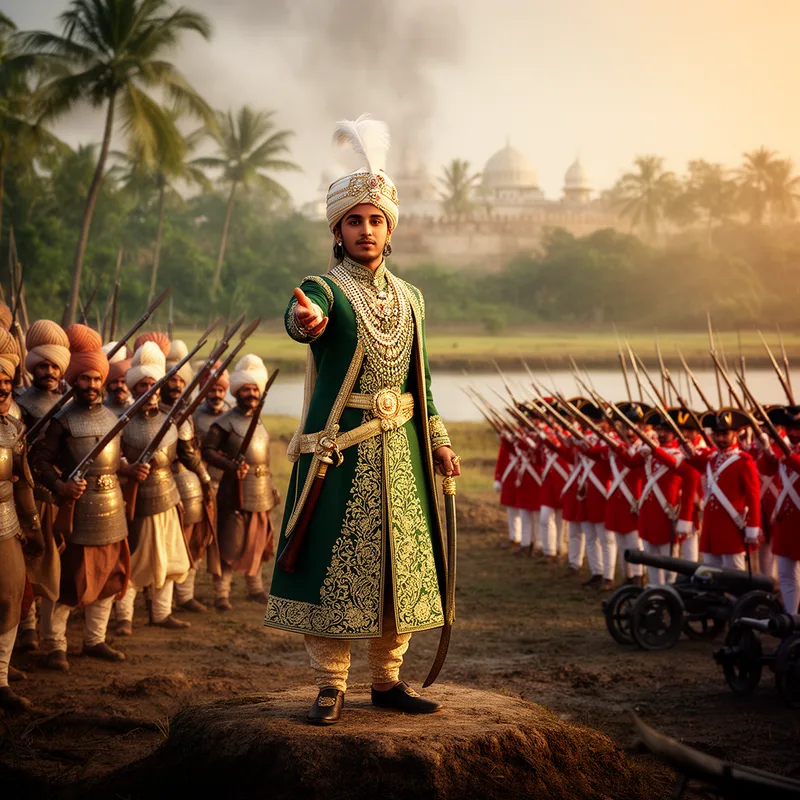
Siraj ud-Daulah


 1
9.9
- proper noun
- Siraj ud-Daulah is remembered for his role in the Battle of Plassey, which changed the course of Indian history.
Examples
-
The events involving Siraj ud-Daulah led to increased British control over Bengal.
-
Many historians debate the legacy of Siraj ud-Daulah and his resistance to British rule.
-
Did Siraj ud-Daulah truly believe he could defeat the British?
-
What strategies did Siraj ud-Daulah employ to resist British rule?
-
Siraj ud-Daulah fought bravely to protect his kingdom from British invasion during the 18th century.
-
In his efforts to resist colonization, Siraj ud-Daulah became a symbol of Indian nationalism.
-
The conflict surrounding Siraj ud-Daulah highlights the struggles faced by Indian rulers against foreign powers.
Surface Forms
Morphology
Siraj + ud-Daulah
This is a proper name referring to a historical person; its constituent elements are non-English name parts (not lexical words in the learner's English dictionary) and do not compose to yield the referential meaning. Proper nouns are arbitrary and culture-specific, so a B1 learner who only 'knows' the name parts would not be able to infer the historical identity or role without prior exposure.
Etymology
Siraj ud-Daulah comes from Arabic: Siraj means 'lamp' and ud-Daulah means 'of the state', so imagine a leader as a lamp meant to light and protect his country. He was the 'last independent Nawab of Bengal' who tried to resist British control, so the name helps you remember his role as the final local ruler defending his land.