

Sinicization


 1
9.9
- noun
- /ˌsɪnɪsəˈzeɪʃən/
- Specialized
- Though encouraging sinicization, it has adopted a policy of allowing all recognized nationalities to use their own languages not only in education but also in the conduct of local government.
Examples
-
Perhaps in a way that is similar to what happened during the "Sinicization" of Buddhism, the religious, academic, and political powers will all play very important roles in the "Sinicization" of Christianity.
Blog text (27) -
Chinese civilization inspired wave upon wave of sinicization in East Asia.
Academic text (1999) -
Perhaps in a way that is similar to what happened during the "Sinicization" of Buddhism, the religious, academic, and political powers will all play very important roles in the "Sinicization" of Christianity.
Blog text (27) -
Therefore, learning from Chinese examples should be described not as a process of Sinicization of early modern Korea but, rather, as an interaction or play between China and Korea that signaled the arrival of a new relationship built on new identities of both states.
Academic text (2015) -
In the age of globalization, with highly developed ideologies, cultures, science and technology, and intricate domestic and international situations, the "Sinicization"
Blog text (27) -
Similar to the Japanese imperialization of Taiwan, the sinicization campaign of the KMT was aimed at both national integration and securing Taiwanese support for its conflict with the Communists on the mainland.
Academic text (2014) -
25 Huang Ying-che: Were Taiwanese Being 'Enslaved'? The Entanglement of Sinicization, Japanization, and Westernization
Academic text (2014) -
The sinicization of various ethnic groups has resulted in a rich tapestry of cultures within China.
-
The school's curriculum reflects the sinicization of education, incorporating Chinese language and traditions.
-
Historians study the sinicization process to understand how regional cultures have adapted to Chinese influences.
Synonyms
 1
9.9
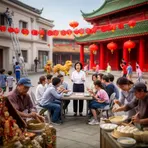
A change that makes people, places, or customs more like Chinese in culture and language
How Chinese

Surface Forms
Morphology
Sinicization = Sinicize (semi-transparent) = sinic + ize + ation
The noun is a regular formation from the verb 'Sinicize' with the process suffix '-ation'.
Etymology
Sinicization comes from the part Sinic- meaning 'Chinese' and the ending -ization meaning 'the process of making or becoming'. So, like Americanization, it describes people, customs, or institutions becoming more Chinese in culture, language, or political ways.