

Sibley tent
- noun
- Archaic
- We assembled the Sibley tent quickly, thanks to its simple tripod design.
Examples
-
Ventilation at the top makes the Sibley tent comfortable even in warm weather.
-
The army supplied each unit with a Sibley tent for shelter during the campaign.
-
The soldiers set up a Sibley tent for shelter.
-
Have you ever slept in a Sibley tent?
-
The explorers set up their Sibley tent in the forest, ready for a long night under the stars.
-
During the expedition, they relied on their Sibley tent for shelter against the elements.
-
In the military training area, a Sibley tent provided a spacious and lightweight accommodation for the troops.
Synonyms

 1
2.5
1
2.5

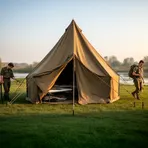
A shelter made from strong heavy canvas cloth used for camping
 1
1.3
1
1.3
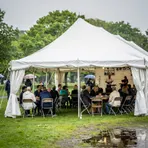
A big shelter made of cloth for people at outdoor events

 1
3.9
1
3.9
A large shelter made of heavy cloth used outdoors by soldiers or campers
How Big

Surface Forms
Morphology
Sibley + tent
The structure is a proper name + noun (Sibley + tent), so a B1 learner who knows 'tent' will understand it denotes a kind or model of tent, but they will not be able to infer the specific conical shape, central tripod, or ventilator from the name 'Sibley' alone. Because the expression yields basic class membership (a tent) but not the detailed properties without prior exposure, it is best classified as semi-transparent.
Etymology
Sibley tent is named after an army officer, Henry Sibley, who designed a simple cone-shaped 'shelter' that stood on a single central tripod and had a top ventilator to let smoke and air out. That's why the name now means a large, light, cone-shaped military tent used for quick 'shelter'.