
Si
 5
4.6
5
4.6

- noun
- /saɪ/
- Specialized
 :
Si
:
Si
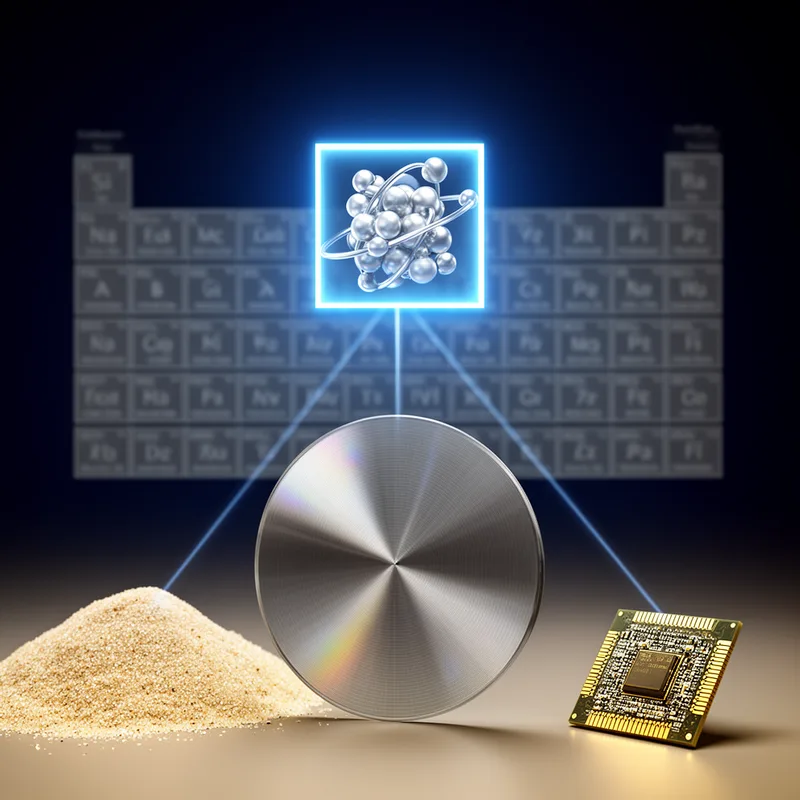
- In electronics, Si serves as a crucial material for manufacturing semiconductors.
- Si atom
- Si bond
- Si wafer
Examples
-
But their focus gradually turned toward the development of Si and gallium arsenide devices for solar-cell applications.
Academic text (2012) -
After bonding is complete, the Si substrate is then completely etched away, leaving the glass support.
Academic text (1995) -
Preliminary experiments on n-type Si show this to be the case.
Academic text (1995) -
Since they are the most tightly bound, the Si atoms at terrace sites are removed last.
Academic text (1998) -
To accomplish this stabilization, Si atoms must be found to fill the holes of the original rest layer.
Academic text (1998) -
The high concentration of Si in the polymer suggests a weak Si/oxide bond.
Academic text (1998) -
The latter lie at higher energy, favoring rehybridization in the presence of Si in comparison to sigma bonds.
Academic text (1998) -
In this case, etching requires halogen atoms to be inserted into strong Si-Si bonds.
Academic text (1998) -
Instead, the surface Si atoms spontaneously dimerize as successive layers are exposed, as in Figure 1c.
Academic text (1998) -
Since surface dimer bonds are weaker than bulk Si-Si bonds, this dimerization actually facilitates further etching.
Academic text (1998)
Synonyms
 38
4.7
38
4.7
A hard, brittle material used in electronics and found in sand and rocks
Compounds



Surface Forms
Etymology
Si stands for silicon, and the name silicon comes from the word silica, which meant 'sand' or 'flint'. So it's easy to remember: Si comes from the stuff of sand and stones, and that is why this element is common in the earth and used in microchips and electronics.