
Shintoism


 1
8.4
- noun
- /ˈʃɪnˌtoʊˌɪzəm/
- The Taiwanese were urged to wear Japanese clothes, adopt Japanese customs, switch from local religions to Shintoism, and speak the Japanese language.
- religions like Shintoism
Examples
-
Thus, an Indian scholar would be responsible for Hinduism, a Japanese scholar from Tokyo for Shintoism, and so on.
Academic text (2010) -
Some Japanese even claim that he came to Japan too and adopted Shintoism (and sired some children).
Blog text (34) -
As I understand it, the dominant philosophical and religious systems are Buddhism and Shintoism.
Blog text (21) -
I especially resonate with your interest in Japan and China, as my minor in university was History, and I studied Eastern history and Shintoism extensively.
Blog text (20) -
Thus, ethnic Jews were followers of the religion of Judaism, and ethnic Japanese were religious followers of Shintoism, etc.
Academic text (2014) -
New religious movements and Buddhism are more prevalent in non-urban areas, while Shintoism is linked to the larger cities.
Academic text (1998) -
And his answer was Tokugawa religion, the unique Japanese blend of Confucianism, Buddhism, and Shintoism.
Academic text (1993) -
Consequently, the new religions tend to be socially active, promoting localism instead of the nationalism of Shintoism.
Academic text (1998) -
The Allied powers issued a memo on December 15, 1945, forbidding the Japanese government to have any relationship with Shintoism, including financial aid to Shinto shrines.
Academic text (1991) -
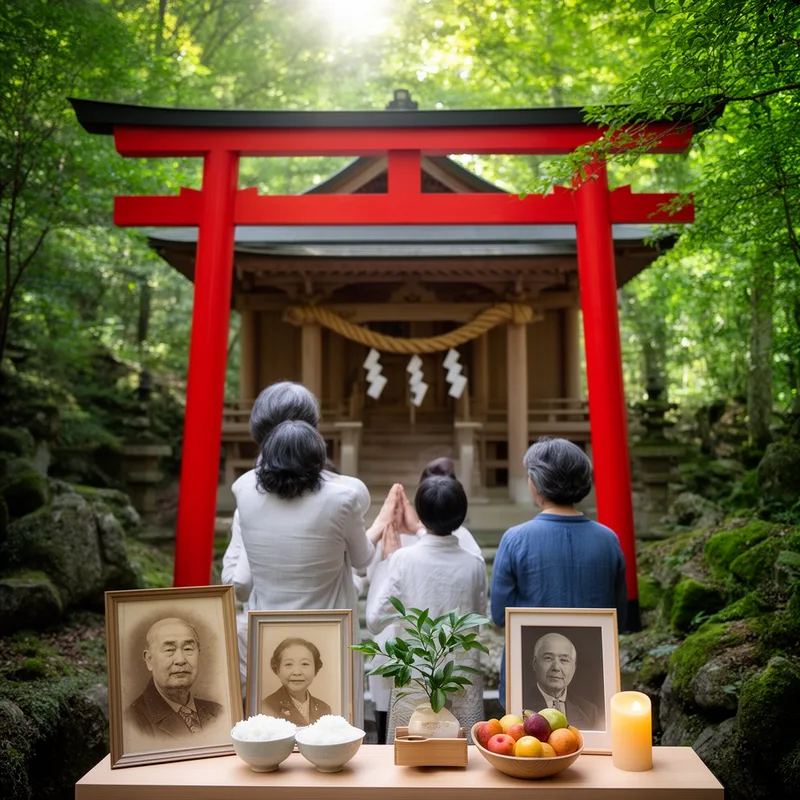
The principles of Shintoism emphasize a deep respect for natural elements like trees, rivers, and mountains.
Synonyms
 3
8.3
A traditional Japanese religion that honors nature spirits and ancestors
Surface Forms
Morphology
Shintoism = Shinto (transparent) = Shinto + ism
The suffix '-ism' straightforwardly forms a religion/ideology noun from the proper name 'Shinto', so the meaning is directly derivable.
Etymology
Shintoism comes from the Japanese Shinto, which is made of shin ('gods' or 'spirits') and tō ('way' or 'path'), so it literally means 'the way of the gods'. The English ending -ism turns it into a belief system, which is why Shintoism is the native Japanese religion that focuses on spirits in nature and ancestors.