
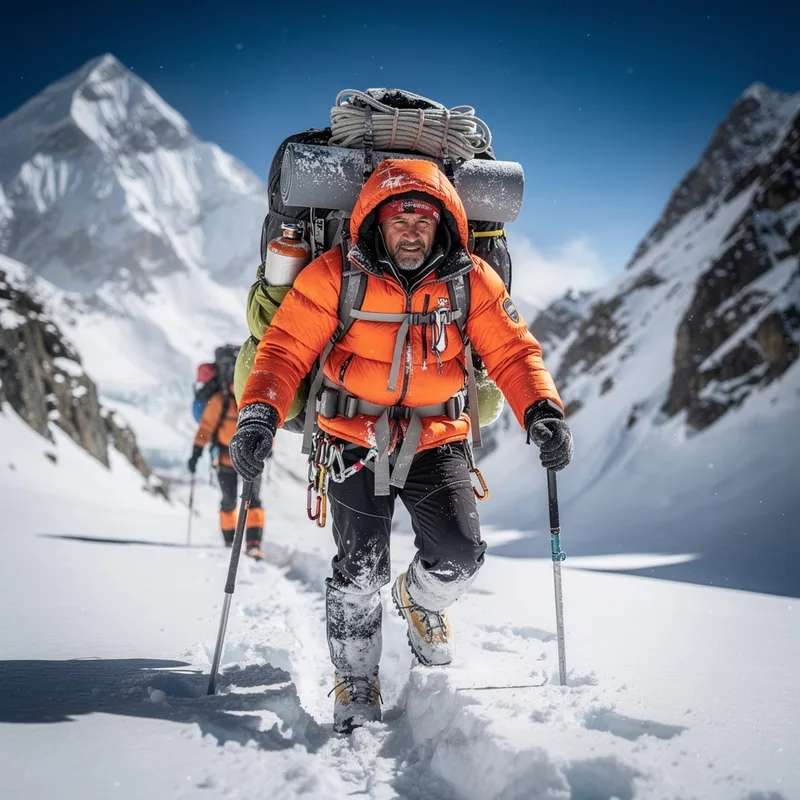
Sherpa
 20
6.8

- noun
- /ˈʃɜr.pə/
- The first Sherpa lodge was opened in Nauje in 1971, and by 1978, seventeen were operating in the region.
- Sherpa household
Loading YouTube…
Watch on YouTubeAnd please don't forget to tip your Sherpas tonight.
- And please don't forget to tip your Sherpas tonight.
- And then there is often an expectation that they are physically bulletproof and Sherpas don't get tired, but they do.
- So we started climbing and the Sherpas were bringing down clients that had tried to summit the day before that were like wacko.
- And we, John and I, had been climbing with two Sherpas, one by the name of Ming Temba and one by the main, excuse me, Lochba Temba and Ming Temba.
- She had a whole team and one member of her team, Tenjin Sherpa, was kind of her primary partner in crime on this.
Examples
-
The Mount Everest region, locally known as Khumbu, is the most famous of these many different Sherpa-settled regions.
Academic text (1993) -
Niblik is my Sherpa guide from the Himalayas.
-
You need a Sherpa guide to sort your way through this mess.
-
"Sometimes there is no difference between a Sherpa and a Western guide."
Blog text (26) -
You look like a Sherpa.
-
The Sherpa-inhabited Mount Everest region of Nepal has become a leading center of Himalayan tourism.
Academic text (1993) -
Tenzing Norgay was the Sherpa that helped Edmund Hillary climb Mount Everest.
-
Tourism earnings and scholarships bestowed by philanthropic tourists have made it commonplace for Sherpa children to be sent outside Khumbu for their education.
Academic text (1993) -
On May 29, 1953, Sir Edmund Hillary and Sherpa Tenzing Norgay became the first to summit Mount Everest.
Blog text (9) -
My guide was a knowledgeable Sherpa who has led many successful climbs in the Himalayas.
Surface Forms
Etymology
Sherpa comes from the Tibetan words shar 'east' and pa 'people', so it originally meant 'people from the east'. Sherpas settled in the high mountains of Nepal and became famous as skilled guides, so today Sherpa also means a guide who helps climbers on very high mountains.