

Serengeti
 13
4.4
13
4.4

- proper noun
- /ˌsɛrənˈɡɛti/
- Craig Packer has studied the lions of the Serengeti since 1978.
- Serengeti National Park
- Serengeti—Mara
- Serengeti Plain
Loading YouTube…
Watch on YouTubeSo we're going to go walk through the Serengeti with an armed guard.
- So we're going to go walk through the Serengeti with an armed guard.
- No different than when a lion is plucked from the Serengeti and put into a zoo.
- We find a little bit later, we find pierced shells in the Serengeti, we find them in North Africa, we find them in the Middle East.
- is the oversight or the administration that maintains and overseas the Ngorongoro Conservation Area and the Serengeti
- So if you look at a lion attacking a gazelle in the middle of the Serengeti, the lion is smelling the molecules in the environment.
- And instead of keeping you free on the Serengeti where you can hunt, you can roar, you can chase, you can explore, they put you in this little fucking cage at the zoo.
- I didn't understand why or how the Serengeti was the way it was.
- So guys, welcome to The Four Seasons Serengeti.
- Also, I want to let you know that I once stood shirtless with Dan, the man Cummins overlooking the African Serengeti.
Examples
-
During the dry season, animals gather around the waterholes in the Serengeti to quench their thirst.
-
My big example here is just the Serengeti Plain in East Africa.
-
Wait till you see the sunrise in the Serengeti.
-
In 1993, for instance, a severe drought reduced the Serengeti population to below 1 million.
Academic text (2006) -
On the plains of the Serengeti, A dung beetle rolls his perfectly sculpted ball of dung.
-
Visitors travel from around the world to witness the great migration on the Serengeti plains.
-
The breathtaking landscapes of the Serengeti are home to many species of wildlife.
Synonyms
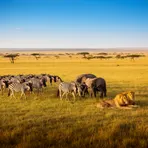
A large flat grassland in northern Tanzania with many wild animals
Compounds

A large park in northern Tanzania with open grassland and many wild animals
Surface Forms
Etymology
Serengeti comes from a Maasai word, siringet, which means 'endless plain' or 'the place where the land goes on and on'. So the name describes the wide open grassland where many wild animals live and make their long migrations each year.