
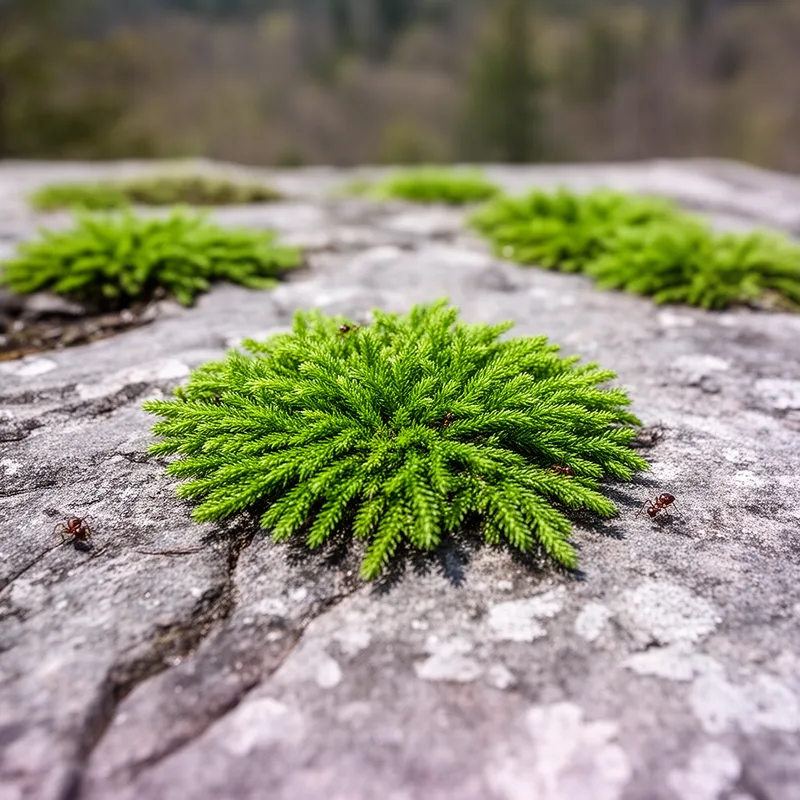
Selaginella rupestris
- noun
- Specialized
- Selaginella rupestris is commonly found growing on rocky outcrops in eastern North America.
Examples
-
The loose mats formed by Selaginella rupestris provide important microhabitats for small insects.
-
Botanists often study Selaginella rupestris for its ability to survive dry conditions.
-
The Selaginella rupestris thrives in rocky environments.
-
Many gardeners appreciate Selaginella rupestris for its unique texture.
-
Selaginella rupestris grows densely on rocky surfaces, forming mats that help prevent soil erosion.
-
In its natural habitat, Selaginella rupestris can be seen thriving among crevices of stones.
-
Selaginella rupestris is an essential part of the ecosystem, providing shelter for various small organisms.
Synonyms

A small green plant that grows in thin mats on rocks

A small low plant that grows in clumps and forms loose mats on the ground in eastern North America
Surface Forms
Morphology
Selaginella + rupestris
The binomial name combines a genus (Selaginella = spike-moss) with a Latin species epithet (rupestris, typically meaning 'rock-dwelling'), so if a learner knew both constituents and biological naming conventions they could infer this is a rock-associated Selaginella. However, the epithet is Latin/technical and not in ordinary dictionaries, and understanding the taxonomic naming convention is specialized knowledge, so the meaning is only partially predictable for a typical B1 learner.
Etymology
Selaginella rupestris gets its name from Latin: Selaginella is a name for a small, moss-like plant and rupestris means 'of the rocks', so the name paints a picture of a little plant that lives on rocks and explains why it grows in rocky places today.

