
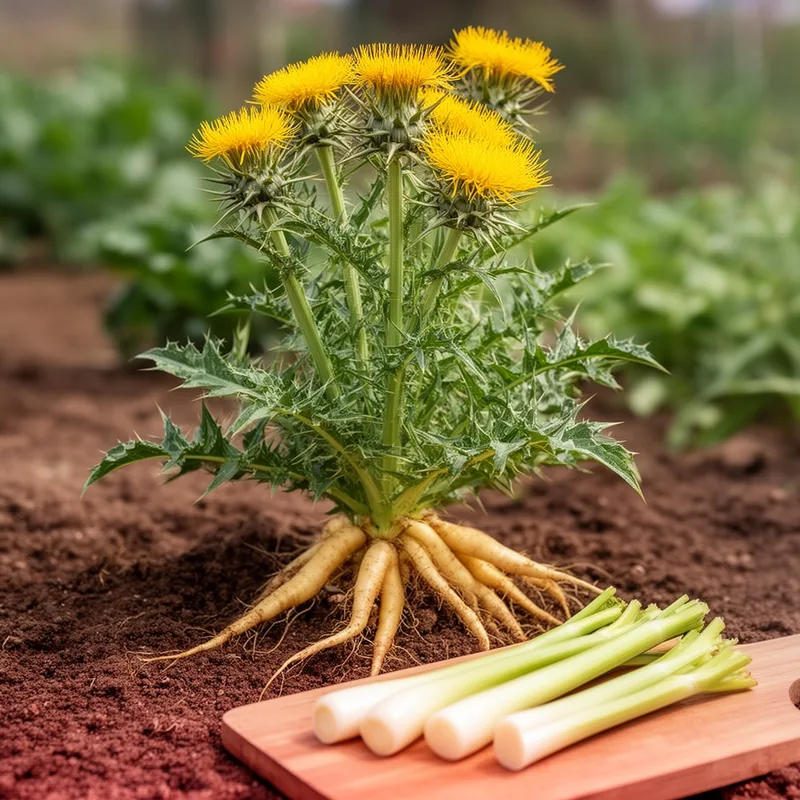
Scolymus hispanicus
- noun
- Specialized
- Gardeners cultivate Scolymus hispanicus for its edible stalks and sweet roots.
Examples
-
In parts of Spain, Scolymus hispanicus is gathered wild and added to traditional stews.
-
The yellow flowers of Scolymus hispanicus are a popular local substitute for saffron in some cuisines.
-
The Scolymus hispanicus is often found in Mediterranean gardens.
-
Have you ever tried Scolymus hispanicus in your cooking?
-
Gardeners cultivate Scolymus hispanicus for its edible stalks and sweet roots.
-
In parts of Spain, Scolymus hispanicus is gathered wild and added to traditional stews.
-
The yellow flowers of Scolymus hispanicus are a popular local substitute for saffron in some cuisines.
Synonyms

A yellow-flowered plant that people grow for its sweet edible roots and leaves

A spiny Mediterranean plant with bright yellow flower heads
Surface Forms
Morphology
Scolymus + hispanicus
This is a Linnaean binomial: 'Scolymus' names the plant genus (a thistle-like herb) and 'hispanicus' is a Latin adjective meaning 'of Hispania/Spain', so a learner who knows both parts could infer it denotes the Scolymus species associated with Spain/southwestern Europe. However, the detailed senses in the gloss (golden thistle, edible sweet roots, saffron substitute) are not recoverable from the constituents alone and Latin adjectival forms are often unfamiliar to B1 learners, so the transparency is only partial.
Etymology
Scolymus hispanicus comes from Latin: Scolymus was an old name for a thistle-like plant and hispanicus means 'from Spain'. So the name paints the image of a yellow, thistle-like plant gathered in Spain for its tasty roots and flowers, which explains why it is the edible golden thistle sometimes used like saffron.

