
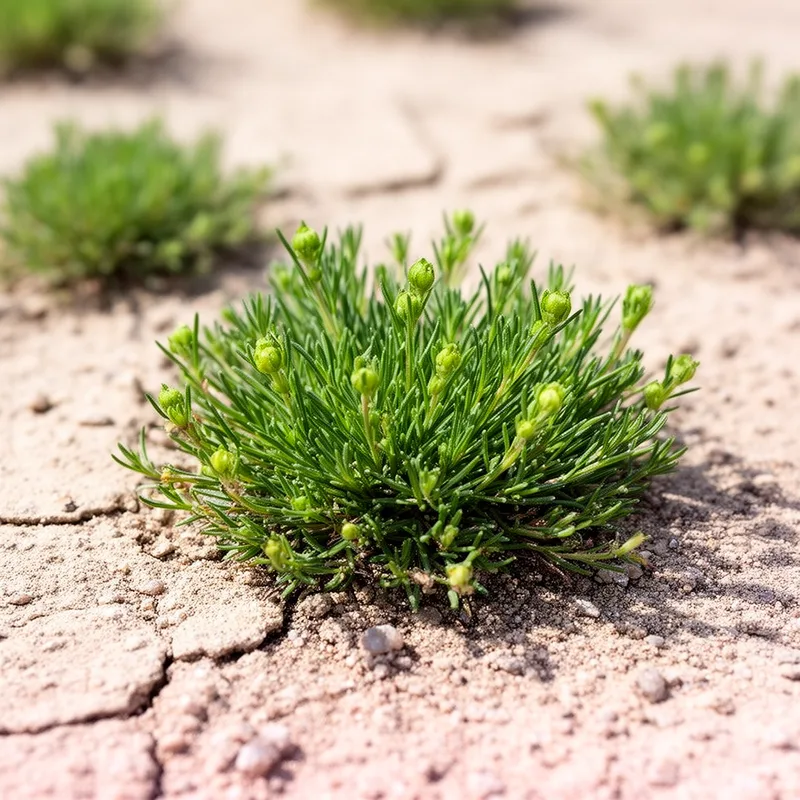
Scleranthus annuus
- noun
- Specialized
- The Scleranthus annuus thrives in dry, sandy soils.
Examples
-
The tiny green flowers of Scleranthus annuus are often overlooked by casual observers.
-
Botanists observed that Scleranthus annuus is well-adapted to nutrient-poor environments.
-
Scleranthus annuus thrives in dry, sandy soils across much of Europe and Asia.
-
Many gardeners appreciate Scleranthus annuus for its resilience.
-
Scleranthus annuus is commonly found in dry, sandy soils throughout Europe and Asia.
-
In dry habitats, Scleranthus annuus can often be seen growing alongside other hardy plants.
-
The narrow leaves of Scleranthus annuus help it conserve water in its arid environment.
Synonyms
A small low plant from Europe and Asia with narrow leaves and small green flowers
A low plant with narrow leaves and small green flowers that grows in sandy soil
Surface Forms
Morphology
Scleranthus + annuus
This is a binomial Latin name composed of the genus Scleranthus (a knawel plant) plus the specific epithet annuus (Latin for 'annual'); if a learner knows both constituents and taxonomic naming conventions, the meaning 'the annual Scleranthus (a low-growing plant)' is directly derivable. Note that 'annuus' is a Latin form and may not appear in ordinary dictionaries, so learners without familiarity with botanical/Latin epithets might not recognize it, but given the premise that the constituents are known the compound is transparent.
Etymology
Scleranthus annuus may come from old Greek and Latin parts: scler- meaning 'hard', -anthus meaning 'flower', and annuus meaning 'one year'. So picture a small, tough plant with plain little flowers that usually lives for one year, and the name helps you remember how it looks and that it only lives one year.

