
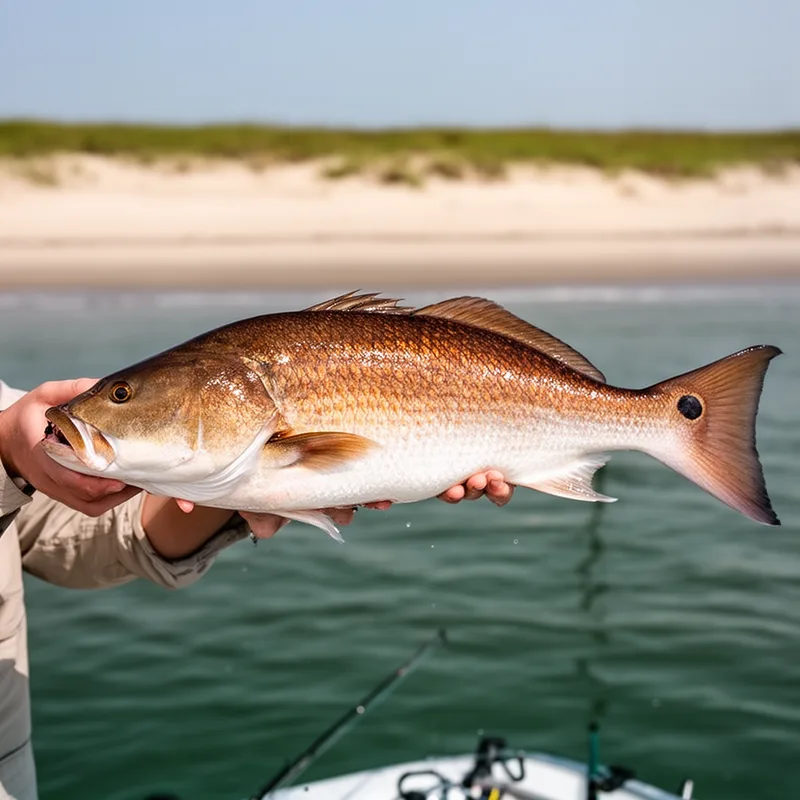
Sciaenops ocellatus
- noun
- /ˈskaɪəˌnɒps oʊˈsɛləˌtəs/
- Specialized
- Conservation efforts have helped restore populations of Sciaenops ocellatus along the Atlantic seaboard.
Examples
-
Many anglers travel to the Gulf Coast hoping to catch a Sciaenops ocellatus for sport and food.
-
The Sciaenops ocellatus is appreciated both by seafood lovers and recreational fishermen.
-
I caught a Sciaenops ocellatus!
-
Have you ever tried Sciaenops ocellatus?
-
Many anglers travel to the Gulf Coast hoping to catch a Sciaenops ocellatus for sport and food.
-
The Sciaenops ocellatus is appreciated both by seafood lovers and recreational fishermen.
-
Conservation efforts have helped restore populations of Sciaenops ocellatus along the Atlantic seaboard.
Synonyms

 1
7.0
1
7.0

A large fish people eat and catch for sport along the United States Atlantic coast

A large saltwater fish often caught for food along the US coast
Surface Forms
Morphology
Sciaenops + ocellatus
This is a Latin scientific binomial (genus + species epithet) whose common-name referent ('red drum') is not compositionally derivable from 'Sciaenops' (a taxonomic label) and 'ocellatus' (an untranslated Latin form). Even if a B1 learner 'knows' those tokens, binomial names function as arbitrary labels and the Latin morphology is not accessible to typical learners, so the meaning is not predictable from the parts.
Etymology
Sciaenops ocellatus comes from old words meaning 'drum' (Sciaenops) and 'little eye' (ocellatus). The fish can make a low drumming sound and has a dark, eye-like spot near its tail, so the name fits the 'red drum', a large fish found along the coast that people catch for food.