
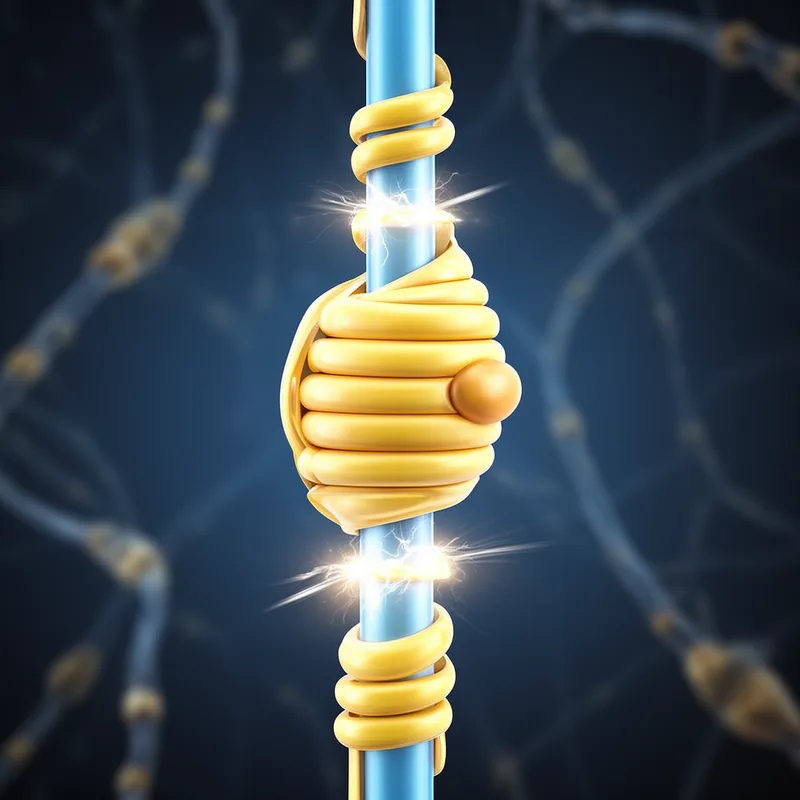
Schwann cell
- noun
- /ʃwɑn kɛl/
- Specialized
- Schwannomas arise from Schwann cells in the nerve sheath.
- arise from Schwann cells
Examples
-
Schwannomas (neurilemmomas) are neurogenic tumors that arise from the Schwann cells of the neural sheath.
Academic text (1996) -
Schwann cells were prepared from p7 Sprague-Dawley rats (male and female).
Academic text (2017) -
Vestibular schwannomas arise from Schwann cells on branches of the vestibulocochlear nerve, most commonly the superior vestibular nerve.
Academic text (2005) -
Schwannomas are benign, encapsulated tumors arising from the Schwann cells of the nerve sheath, and were originally described by Stout in 1935.
Academic text (2007) -
Schwann cells play a crucial role in forming the myelin sheath around peripheral nerve fibers.
-
In the peripheral nervous system, Schwann cells protect and insulate nerve fibers by producing the myelin sheath.
-
The function of Schwann cells is essential for the regeneration of peripheral nerves after injury.
Surface Forms
Morphology
The headword 'cell' makes it clear to a B1 learner that this is a type of biological cell, so they can infer a general category. However 'Schwann' is an eponym that gives no information about function, so the specific role (insulating nerve fibers and forming myelin) cannot be derived from the constituents alone.
Etymology
Schwann cell gets its name from a scientist called Schwann and the word cell for a tiny living unit. He described cells that 'wrap around' nerve fibers like insulation, 'insulating' them and 'helping signals move faster', so the name now means the cells that form the protective layer around nerves.

