
Savonarola


 1
9.9
- proper noun
- /ˌsævəˈnɔːrələ/
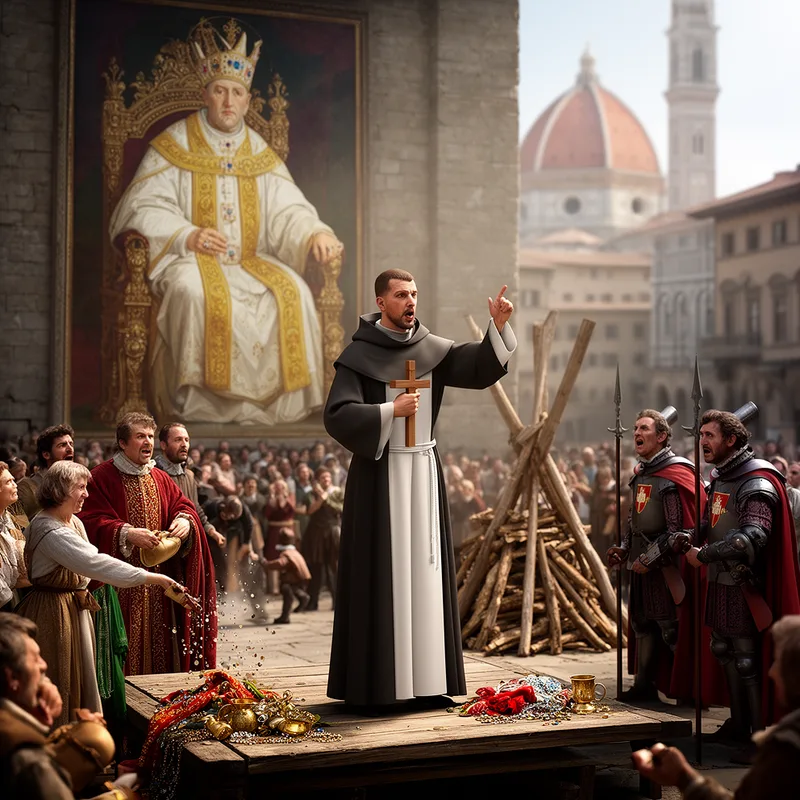
- A painting in the museum shows the dramatic execution of the Dominican friar Savonarola who was burned at the stake in 1498.
- Girolamo Savonarola
Examples
-
When a painter used his skills to moral effect, it could induce the kind of heightened spiritual reaction in the viewer that Girolamo Savonarola saw as shadowing God's love.
Academic text (2006) -
As Savonarola and Erasmus well knew, the more skillful a painter, the more emotionally affecting his works could be, with potentially morally dangerous consequences.
Academic text (2006) -
Church history keeps coming back to Gioachino de' Fiori and Savonarola...
Blog text (10) -
While Lippi was completing the Strozzi commission, Florentines were listening to Savonarola inveighing against the deceitful seductions of modern painters:
Academic text (2002) -
The bonfires of "the vanities" that Savonarola instigated, although mostly understood as acts of religious purification, produced a carefully orchestrated visual effect that replaced a prolific artistic production with a sense of absence.
Academic text (2011) -
Savonarola directed his criticism against the aphorism "Every painter paints himself." The dictum had been current in Florence since the 1470s, and for Savonarola, it epitomized a deeply felt retreat from the Christian cult value of pictures toward a cult of art and artists.
Academic text (2011) -
We can trace the creation of contrafacta at least as far back as the fifteenth century, when the Italian friar Savonarola replaced the lyrics of secular carnival songs with sacred texts (Fenlon 63-65).
Academic text (2015) -
Florentines were captivated by the sermons of Savonarola, who passionately condemned the sins of society and sought to reform the city.
-
The influence of Savonarola in Renaissance Florence led to significant changes in the religious and cultural landscape of the city.
Surface Forms
Etymology
Savonarola is an Italian family name likely linked to the town Savona in Italy. A helpful way to remember him is to think of Savonarola as 'the man from Savona', which fits because he was an Italian friar and reformer in Florence.