

Sarcosporidia
- noun
- /sɑrˈkoʊspəˌrɪdiə/
- Specialized
- Infections caused by Sarcosporidia can lead to severe muscle damage.
Examples
-
Veterinarians monitor the presence of Sarcosporidia to prevent outbreaks in farm animals.
-
The lifecycle of Sarcosporidia involves both a definitive and an intermediate host.
-
Sarcosporidia are often detected in the skeletal muscles of livestock during post-mortem examinations.
-
The Sarcosporidia are known to affect livestock.
-
Sarcosporidia are microscopic parasites found in the muscles of many vertebrates, sometimes leading to serious health issues.
-
Farmers regularly check for Sarcosporidia in livestock to ensure they remain healthy and disease-free.
-
The presence of Sarcosporidia in infected animals can be confirmed through laboratory testing of muscle samples.
Synonyms
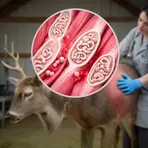
A group of parasites that live in the muscles of animals and cause disease
Compounds
- Specialized
A group of parasites that live in the muscles of animals and cause disease
Surface Forms
Morphology
Sarcosporidia = Sarcosporidium (opaque) = sarco + sporidium + a
This is a Latinized taxonomic plural formed from classical combining forms; the components are specialist scientific morphemes not familiar or productive for average learners, so the meaning cannot be derived from them.
Etymology
Sarcosporidia comes from Greek parts sarc- meaning 'flesh' and spora meaning 'seed' or 'spore'. So the name is like 'flesh spores', a helpful image for the tiny spore-like parasites that live in the muscles of animals.

