
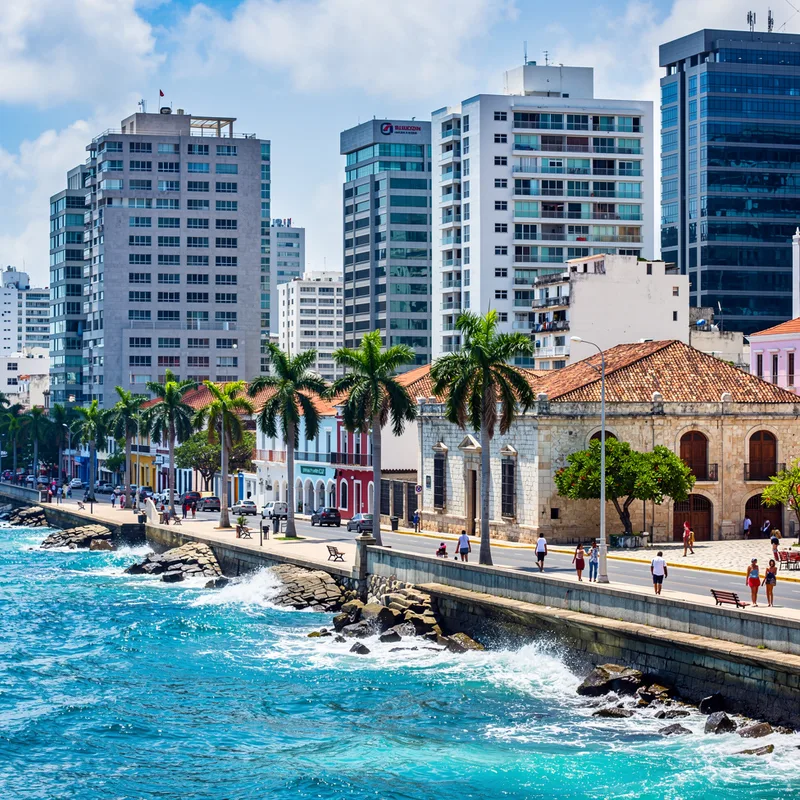
Santo Domingo
 6
3.0

- proper noun
- /ˈsɑːntoʊ dɪˈmoʊŋɡoʊ/
- An All Pueblo Council was called at Santo Domingo by the governor of Acoma soon after the dance order was issued.
Examples
-
By 1971, a larger number of Japanese families (fifty-six) was reported to be living in the city of Santo Domingo than within the former colonies (thirty-seven).
Academic text (2000) -
Following the initial rush of Japanese colonists to the city of Santo Domingo, a number of families began to reestablish themselves in smaller communities, primarily to the east and west of the capital.
Academic text (2000) -
Nor are you to return to Santo Domingo or any of the other colonies.
Fiction book (1992) -
Diego is thinking of starting a pearl trade in Santo Domingo...
Fiction book (1992) -
The sample, interviewed in March 1987, is 255 residents of Santo Domingo aged 15 and above.
Academic text (1991) -
Alfredo began life in the capital, Santo Domingo, but came to Guachupita after the 1965 Revolution.
Academic text (1994) -
The most famous, but probably not the most representative black parishioner, Pierre Toussaint was born a slave in Santo Domingo in 1766.
Academic text (1993) -
By September 1959, a total of 1,319 Japanese had arrived in Ciudad Trujillo (as Santo Domingo was called during the generalissimo's rule), the capital city.
Academic text (2000) -
In keeping with Japanese traditions, they have established well-regarded schools of martial arts in Santo Domingo and Santiago (Matsunaga 1991; Sakamoto 1991).
Academic text (2000) -
While we were in Santo Domingo, we lived at a house run by a Christian organization.
Surface Forms
Morphology
Santo + Domingo
This is a toponym/proper name: knowing the constituents (Spanish santo/domingo ≈ 'saint'/'Sunday') does not let a B1 English learner infer that the phrase names the capital and largest city of the Dominican Republic. Place names are lexicalized and arbitrary (even if etymologically transparent), so the referential meaning is not derivable from the parts.
Etymology
Santo Domingo is a Spanish name that literally mixes Santo 'saint' and Domingo 'Dominic'. Early Spanish settlers named the town for 'Saint Dominic', and that name stayed as the city grew into the country's capital.