
Santeria
 8
9.7

- noun
- /ˌsæn.təˈri.ə/
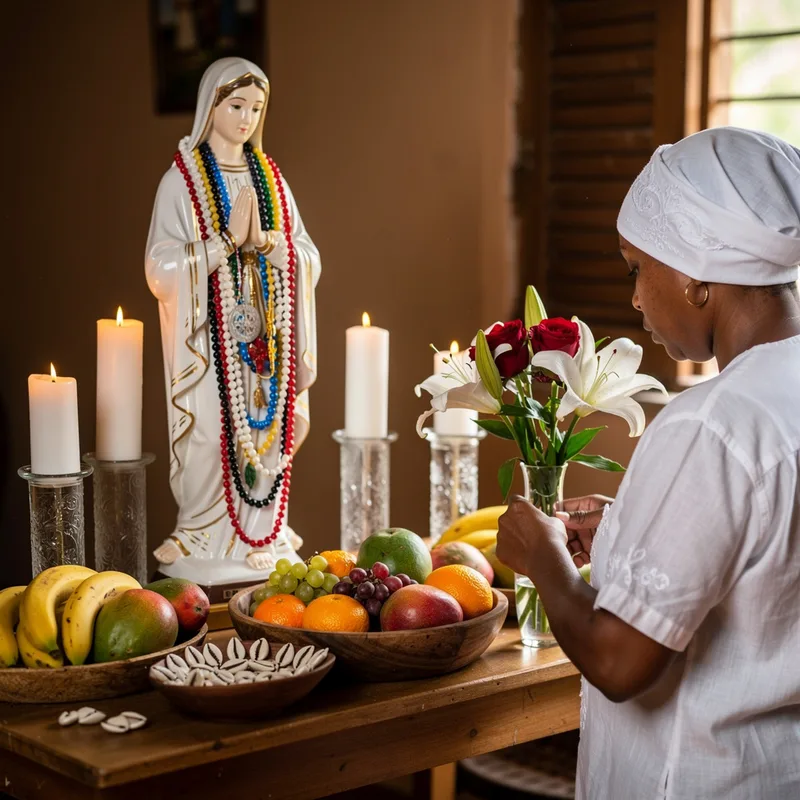
- "Santeria is a merging of West African and Catholic beliefs; it is a borrowing of religions."
- Santeria, La Regla
- Cuban Santeria
Loading YouTube…
Watch on YouTubeAnd it was a Santeria spell cast on someone to make them fall in love.
- And it was a Santeria spell cast on someone to make them fall in love.
Examples
-
Common among Caribbean immigrants, Santeria blends Catholic iconography with West African traditions.
-
The spirits' names are given in Congo-Spanish, along with their equivalents in Lucumi (Yoruba-based religion also known as Santeria and La Regla de Ocha) and Catholicism.
Academic text (2001) -
Santeria has spread from a base in Cuba to many large North American cities.
Academic text (1990) -
Shango and Santa Barbara were syncretized in Santeria because enslaved people in Cuba were forced to convert to Catholicism.
Blog text (2) -
Writing for the Court, Justice Kennedy found that public officials had "disclosed animosity to Santeria adherents," which violated the requirement of neutrality.
Academic text (2018) -
But in Oriente Province, the priests of Santeria, the santeros, have spoken for generations about the magical curative powers of Oriente bear fat.
Fiction book (1996) -
We are here today with Eva Delgado, a self-proclaimed Santeria priestess who practices ancient rituals.
-
Angie asked where she could find El Viejo, so Lidia directed her to a local Santeria shop on Bowen Street.
Surface Forms
Etymology
Santeria comes from the Spanish word santo ('saint') plus the ending -ería ('practice' or 'place'). It names the religion in Cuba and the Caribbean that mixes West African Yoruba spirits called 'orishas' with Catholic saints, so thinking of 'santo' or 'saint' helps explain why saints play a big role in its ceremonies.