

Sambucus ebulus
- noun
- UK
- A field guide described Sambucus ebulus as a dwarf herbaceous elder characterized by its pink flowers.
Examples
-
The roots and berries of Sambucus ebulus have been used in traditional medicine in Europe.
-
Botanists distinguish Sambucus ebulus from other elders by its upright herbaceous stems.
-
A field guide noted the unpleasant odor of Sambucus ebulus when the leaves are crushed.
-
The Sambucus ebulus is often found in wet areas.
-
I discovered a patch of Sambucus ebulus near the river.
-
When crushed, the leaves of Sambucus ebulus emit a disagreeable smell that many find unpleasant.
-
In European folklore, Sambucus ebulus has traditionally been noted for its distinctive odor.
Synonyms

A small European bush with pink flowers and a strong bad smell
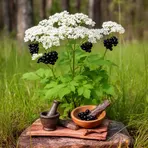
A small wild plant with strong-smelling white flowers and black berries used in medicine
Surface Forms
Morphology
Sambucus + ebulus
This is a technical Latin binomial (genus + specific epithet). The specific element 'ebulus' is not an English word and is listed as not found, and the full descriptive meaning (a dwarf herbaceous elder with pink flowers and a disagreeable smell) requires botanical knowledge rather than straightforward composition, so a B1 learner knowing the parts would not be able to derive the meaning.
Etymology
Sambucus ebulus may come from old words meaning 'elder' and 'small', with Sambucus for 'elder' and ebulus for 'small', so the name gives the image of a little elder plant. That's why the name fits this low, herb-like elder with pink flowers and a strong, unpleasant smell.

