
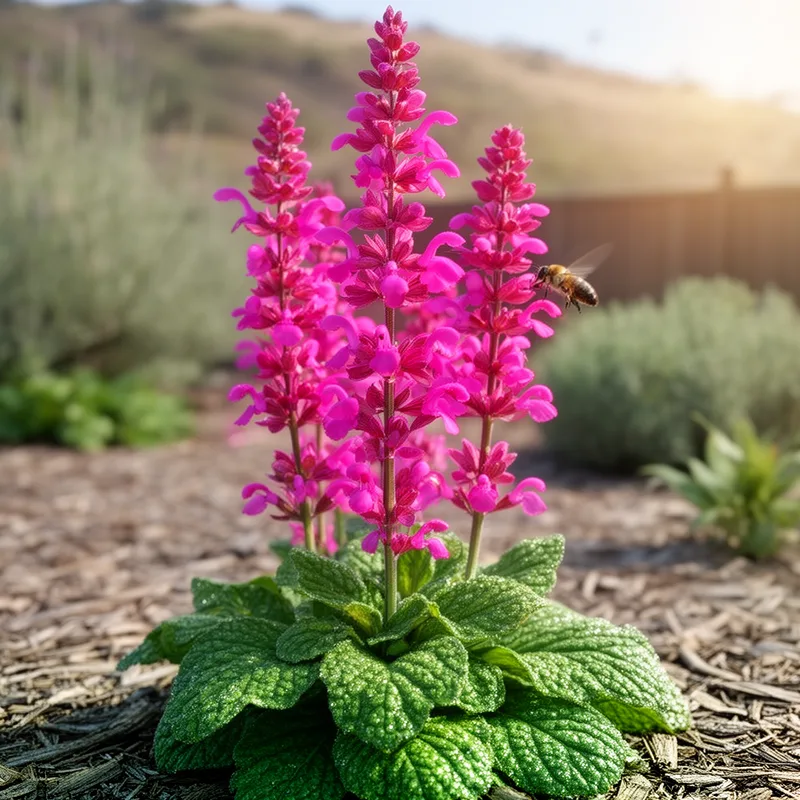
Salvia spathacea
- noun
- Specialized
- Gardeners plant Salvia spathacea to attract hummingbirds and pollinators to their yards.
Examples
-
Salvia spathacea is known for its striking magenta flowers and aromatic leaves, making it a favorite among gardeners in California.
-
The drought-tolerant Salvia spathacea is a popular choice for native California gardens.
-
Salvia spathacea thrives in coastal California and is valued for its fragrant leaves and vibrant flowers.
-
The Salvia spathacea blooms beautifully in the spring.
-
Many gardeners love Salvia spathacea for its vibrant colors.
-
Many California gardeners choose to plant Salvia spathacea because it attracts a variety of pollinators to their gardens.
-
The fragrant blooms of Salvia spathacea can be seen lining the paths of many native plant gardens throughout coastal California.
Synonyms
A California plant with woolly stems and large white flowers
Surface Forms
Morphology
salvia + spathacea
This is a Latin binomial (genus + specific epithet), so a learner who knows 'salvia' can transparently infer it denotes a kind of sage; however the second element 'spathacea' is a specialized/Latin epithet whose specific descriptive meaning is not accessible to an average B1 learner. Thus the overall label as a species is derivable but the detailed sense is not, giving partial transparency.
Etymology
Salvia spathacea may come from old words that describe the plant: Salvia was a word for 'healing' and the sage plants, and spathacea refers to a leaf-like part that 'wraps the flowers'. So the name fits this fragrant sage whose leaves seem to hug its bright flowers.

