
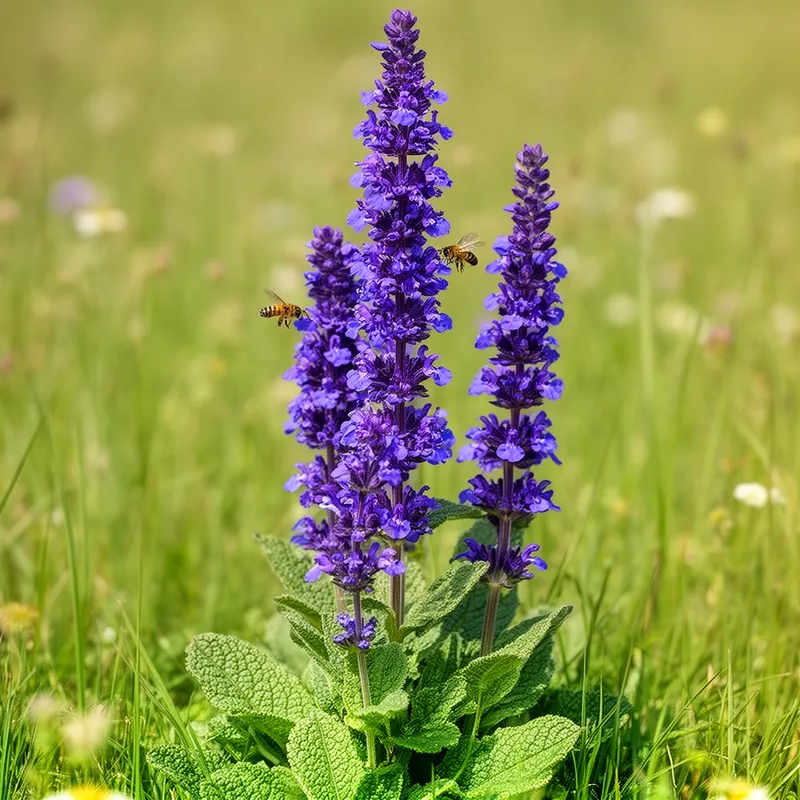
Salvia pratensis
- noun
- Specialized
- In the meadow, patches of Salvia pratensis added vibrant blue color during the summer.
Examples
-
Gardeners often plant Salvia pratensis to attract bees and butterflies.
-
The distinctive leaves of Salvia pratensis make it easy to identify among other wildflowers.
-
Look at the Salvia pratensis!
-
The garden features beautiful Salvia pratensis blooming in the spring.
-
In the meadow, patches of Salvia pratensis added vibrant blue color during the summer.
-
The garden features beautiful Salvia pratensis blooming in the spring.
-
Gardeners often plant Salvia pratensis to attract bees and butterflies.
Synonyms

A tall plant with blue flowers that grows in open grasslands
Surface Forms
Morphology
salvia + pratensis
The name is a scientific Latin binomial: 'salvia' denotes the sage genus and 'pratensis' (Latin) means 'of the meadow', so if a learner knew both elements they could reconstruct 'meadow sage'. However, 'pratensis' is not an English word and is absent from the given dictionary entry, making the composition domain-specific and unlikely to be predictable to an average B1 learner without botanical/Latin knowledge.
Etymology
Salvia pratensis comes from two Latin words: Salvia from an old word for 'to heal' because sage plants were used as medicine, and pratensis meaning 'of the meadow'. So the name paints the picture 'meadow sage', which helps you remember it is a wild, blue-flowered sage that grows in open grasslands.

