
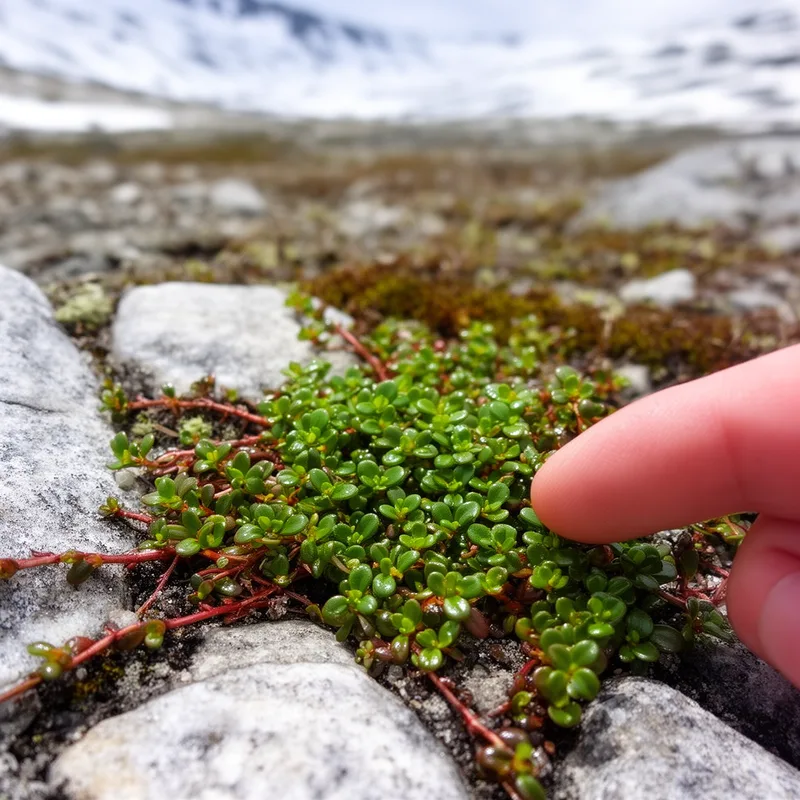
Salix herbacea
- noun
- Specialized
- Salix herbacea grows in tundra regions, adapting to harsh winter conditions.
Examples
-
Researchers study Salix herbacea to understand plant adaptation in cold climates.
-
The bright leaves of Salix herbacea stand out against the rocky landscape.
-
Salix herbacea is often found in alpine and arctic tundra environments.
-
Salix herbacea is often found in alpine regions.
-
The Salix herbacea thrives in cold climates.
-
In remote areas, Salix herbacea serves as a vital species for stabilizing soil.
-
The glossy green leaves of Salix herbacea provide a unique contrast in its rocky habitat.
Synonyms
A very small willow plant that grows low on cold mountains and in Arctic places
Surface Forms
Morphology
Salix + herbacea
The binomial is compositionally built from 'Salix' (willow) + 'herbacea' (herbaceous), so a learner who knows those constituents can infer a willow that is herb-like or small; the basic category ('herbaceous willow') is derivable. However, the full descriptive meaning (boreal, shrubby with creeping stems and glossy leaves) contains specific botanical details not predictable from the parts alone and the Latin epithet may be unfamiliar to many learners, so comprehension is only partial.
Etymology
Salix herbacea comes from Latin words: Salix means 'willow' and herbacea means 'herb-like' or small and low to the ground. The name gives a picture of a tiny willow that grows close to the ground, which is why it refers to this very small willow found in northern regions.

