
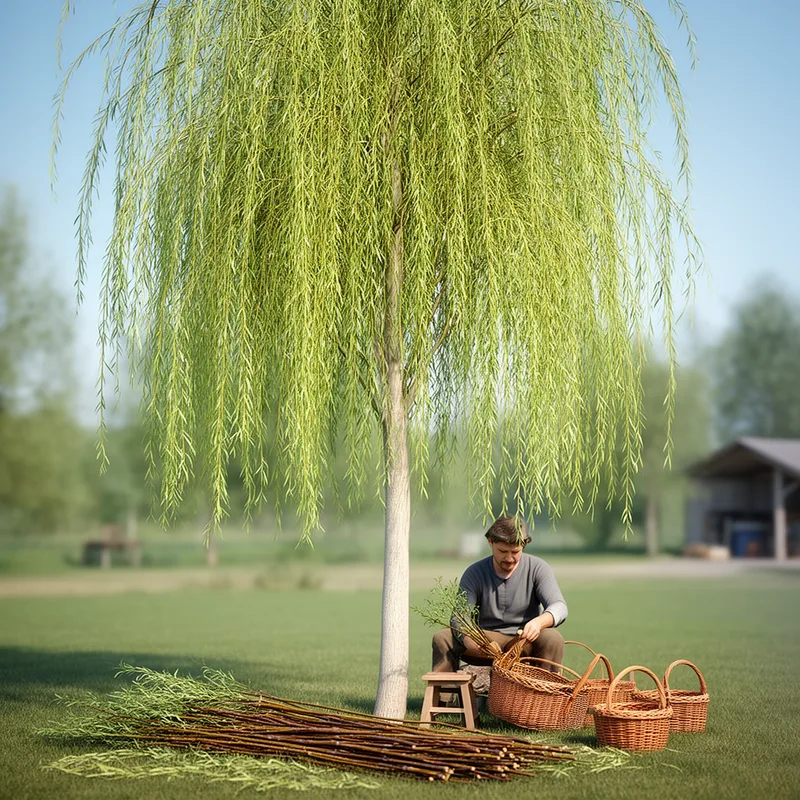
Salix amygdalina
- noun
- Specialized
- Salix amygdalina is often cultivated for basketry due to its flexible branches and light green foliage.
Examples
-
Salix amygdalina is prized in some regions for the flexibility of its branches in traditional basket weaving.
-
Unlike other willows, Salix amygdalina has distinctly light green leaves that make it easy to identify.
-
Many craftspeople grow Salix amygdalina to harvest its shoots annually for their workshops.
-
The Salix amygdalina tree grows near the river.
-
Many gardeners prefer Salix amygdalina for its flexibility.
-
Craftspeople utilize Salix amygdalina for making baskets because its shoots are strong and resilient.
-
Salix amygdalina is recognized by its slender branches, making it a favorite among artisans for weaving projects.
Synonyms

A willow tree with light green leaves grown for making baskets

A willow tree with light green leaves used for making baskets

A type of willow with light green leaves grown for making baskets
Surface Forms
Morphology
Salix + amygdalina
The first element 'Salix' is the Latin genus name for willows, so a learner who knows that and the second element could infer this is the name of a willow species rather than a noncompositional idiom. However, the phrase is a scientific binomial (Latin epithet) and understanding its status as a species name and any descriptive nuance of 'amygdalina' depends on knowledge of taxonomic naming and Latin-derived epithets, which a B1 learner may not possess, making full meaning only partly predictable.
Etymology
Salix amygdalina comes from Latin plant words: Salix is Latin for 'willow' and amygdalina means 'almond-like' because the leaves are narrow and look a little like almonds. That's why the name tells us it is a willow with light green, almond-shaped leaves that people grow for basket making.

