
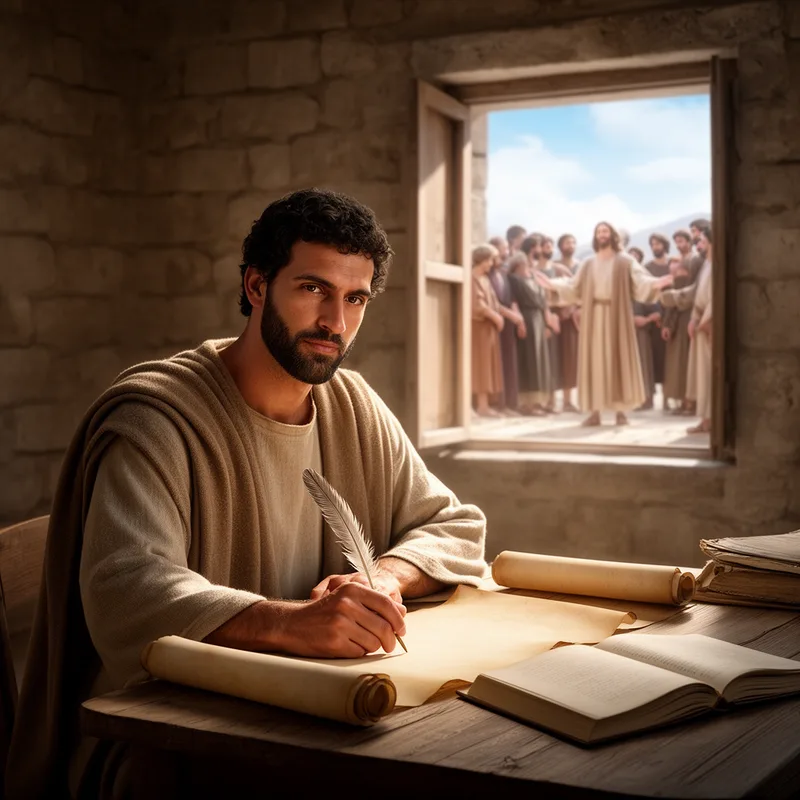
Saint Matthew the Apostle
- proper noun
- In religious art, Saint Matthew the Apostle is frequently depicted with a book or scroll, symbolizing his role as an evangelist.
Examples
-
The Gospel according to Saint Matthew the Apostle is often cited for its unique perspective on Jesus' teachings.
-
According to tradition, Saint Matthew the Apostle was a tax collector.
-
Many churches are named after Saint Matthew the Apostle in recognition of his contributions to Christianity.
-
Many people celebrate the feast day of Saint Matthew the Apostle on September 21.
-
In religious art, Saint Matthew the Apostle is frequently depicted with a book or scroll, symbolizing his role as an evangelist.
-
Many churches are named after Saint Matthew the Apostle in recognition of his contributions to Christianity.
-
The Gospel according to Saint Matthew the Apostle is often cited for its unique perspective on Jesus' teachings.
Synonyms

 61
7.9
61
7.9

A follower of Jesus said to be the writer of the Gospel of Matthew
 26
1.7
26
1.7
One of Jesus' twelve followers who was a tax collector and is often said to have written the first Gospel


 1
4.7
1
4.7
One of Jesus's twelve followers in the Bible, often shown holding a book
One of the twelve followers of Jesus who is said to have written the first Gospel in the New Testament

A follower of Jesus who people say wrote the first Gospel
Surface Forms
Morphology
saint + Matthew + the + Apostle
The phrase is fully compositional: a learner who knows 'saint' (holy person), 'Matthew' (a personal name) and 'apostle' (a disciple of Jesus) can readily infer this refers to a holy person named Matthew who is one of the apostles. Religious honorifics and titles combine transparently across many languages, so a B1 learner familiar with the constituent words will understand the referent without prior exposure.
Etymology
Saint Matthew the Apostle is the name for Matthew, one of Jesus' twelve followers who became a holy person; the words Saint and Apostle show he is seen as a 'saint' and a 'apostle' or special messenger. He is often shown with a book because people believe he wrote the 'Gospel' that tells Jesus' life, so the title links him to both being a holy man and the writer who told Jesus' story.