
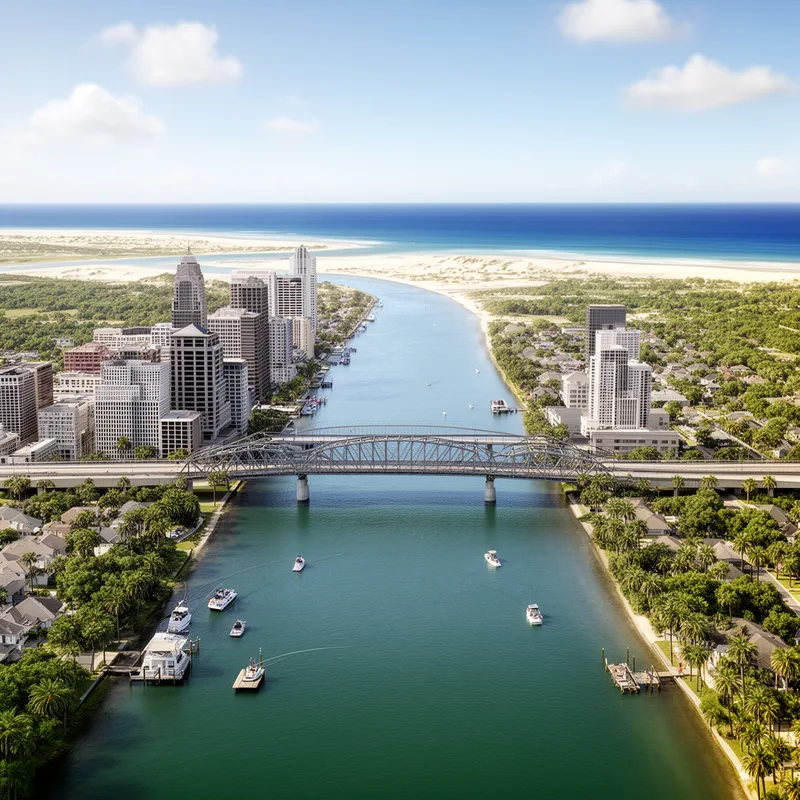
Saint Johns
- proper noun
- /seɪnt dʒɒnz/
- Many people enjoy boating and fishing along the Saint Johns each year.
- the Upper Saint Johns
Examples
-
Fishermen often flock to the Saint Johns for its plentiful bass and quiet waters throughout the year.
-
After heavy rainfall, the Saint Johns can quickly rise, prompting local authorities to issue flood warnings.
-
The Saint Johns is one of the few rivers in North America that flows northward.
-
The city of Jacksonville grew along the banks of the Saint Johns River.
-
The Saint Johns River is known for its scenic beauty.
-
Many people enjoy fishing in the Saint Johns River.
-
The Saint Johns River is known for its scenic beauty as it winds through Jacksonville before reaching the Atlantic Ocean.
Synonyms



 1
3.2
1
3.2
A long river in northeast Florida that flows north to Jacksonville and east to the Atlantic Ocean

A river in northeast Florida that flows north through Jacksonville to the Atlantic Ocean

A big river in northeast Florida that flows north to Jacksonville and then east to the Atlantic Ocean
Surface Forms
Morphology
Saint + Johns
The elements 'Saint' + 'Johns' clearly signal a toponym derived from a saint’s name, so learners who know the words can infer it is a place-name associated with Saint John. However, this does not transparently convey the specific referent (that it is a particular river in northeastern Florida) without additional context or exposure, so the relation is only partially predictable.
Etymology
Saint Johns was named by early explorers. One popular story says they first saw the river on the day for Saint John, so they called it Saint Johns, which is why the name still refers to the river today.