
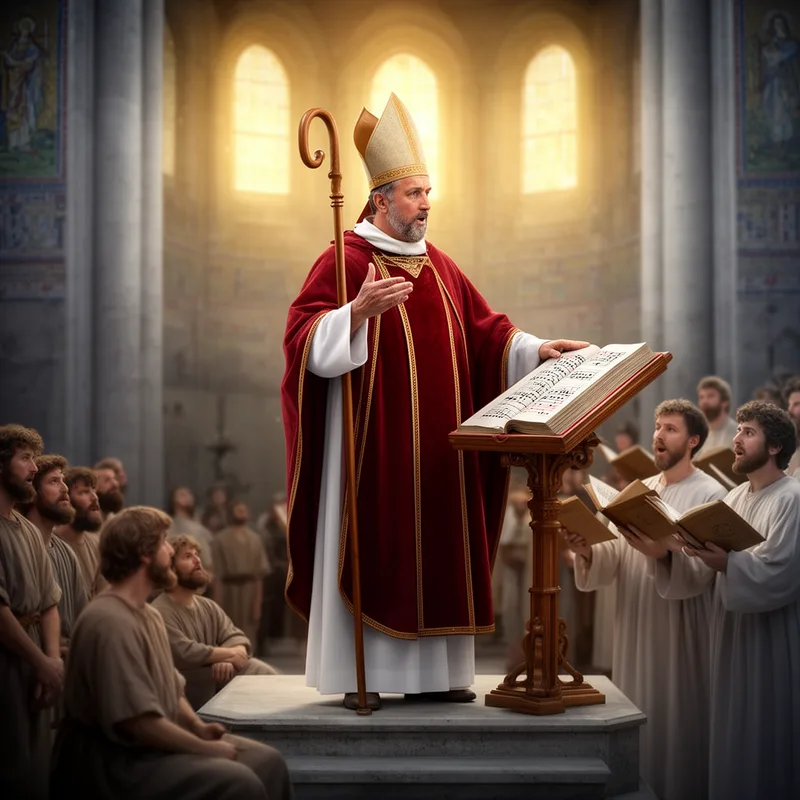
Saint Ambrose
- proper noun
- /seɪnt ˈæm.broʊz/
- The hymns written by Saint Ambrose are still sung in some churches today.
Examples
-
Many scholars study the sermons of Saint Ambrose to understand early Christian theology.
-
Saint Ambrose was instrumental in establishing many traditions of the early Christian Church.
-
The teachings of Saint Ambrose greatly influenced Christian theology.
-
Did Saint Ambrose write any hymns?
-
Saint Ambrose was instrumental in shaping the doctrines of the early Christian Church.
-
Many theologians continue to reference the works of Saint Ambrose for insights into early Church practices.
-
The legacy of Saint Ambrose is evident in the liturgical traditions observed in modern Christianity.
Synonyms
 98
9.1
98
9.1

An important early Christian bishop in Milan who became a saint and wrote hymns that shaped church beliefs

A bishop of Milan in the 300s who helped shape the early Christian church and wrote hymns
Surface Forms
Morphology
The phrase is compositionally built from 'saint' + a proper name, so a learner who knows 'saint' will understand it denotes a holy or canonized person named Ambrose; the specific historical details (dates, role as bishop) are not derivable but the core referent is. This naming pattern is cross-linguistically common, making the expression transparent at a B1 level.
Etymology
Saint Ambrose was a church leader in Milan around the year 300 who helped shape early Christian worship by writing hymns and even standing up to an emperor to protect the church. So when people say Saint Ambrose today, they mean that important early church figure, which is why many churches and schools use his name.