

Ruhr


 1
7.4
1
7.4
- proper noun
 :
Ruhr
:
Ruhr
- The balance of power in Europe depended in part on who controlled the coal and steel in the Ruhr Basin.
- Ruhr Valley
- Ruhr region
Examples
-
The Ruhr region is known for its extensive coal mines and steel production facilities.
-
Duisburg is located on the Rhine River and belongs to the Ruhr District, formerly an important agglomeration area in Germany for heavy industries.
Academic text (2014) -
The Ruhr region, with a high concentration of German industrial capacity, was a promising target.
Academic text (1991) -
Again, British authorities were concerned that bombing raids on the Ruhr would also result in the deaths of large numbers of civilians.
Academic text (1991) -
Industry in Germany is at its lowest ebb except for some coal mining in the Ruhr.
Academic text (2003) -
In November 1928, 220,000 metalworkers were locked out in the Ruhr region.
Academic text (2000) -
There is little sense in setting the same standards for the highly industrialized Ruhr Valley and agrarian southern Bavaria, and it is unlikely that the standards would be equally enforced by local authorities.
Academic text (1991) -
Contrary to what is often assumed, internal migrants (be they the Bretons in Paris, the Irish in Liverpool, or the East Prussians in the Ruhr district) also had to adapt to their new environment and experienced, to a certain extent, similar adaptation processes.
Academic text (2002) -
In the Ruhr Valley, the industrial landscape is dotted with factories and coal pits.
-
During the industrial revolution, the Ruhr became a key area for coal mining and heavy industry in Germany.
Synonyms
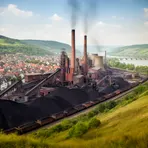
An industrial region in northwest Germany known for coal mining and factories
Compounds

A river in western Germany that flows into the Rhine and runs through the industrial Ruhr area
Surface Forms
Etymology
Ruhr the region is named after the Ruhr river, and 'Ruhr' probably meant 'rushing' water; towns and coal mines grew along that valley, so the name now stands for Germany's big industrial area.