

Rubus flagellaris
- noun
- Specialized
- The berries produced by Rubus flagellaris are juicy and delicious when eaten fresh or used in desserts.
Examples
-
Gardeners often plant Rubus flagellaris to attract wildlife and enjoy its edible fruit.
-
Rubus flagellaris can be found growing wild along roadsides and open fields in the eastern United States.
-
Rubus flagellaris is commonly found in the wild.
-
Many people enjoy picking Rubus flagellaris in the summer.
-
Rubus flagellaris produces sweet blackberries that are a favorite among foragers in the summer.
-
When hiking in eastern North America, you might spot Rubus flagellaris thriving along the trail.
-
Children love to pick Rubus flagellaris berries to make jam during family outings.
Synonyms
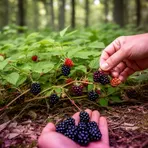
A low wild plant that makes small black edible berries like blackberries
Surface Forms
Morphology
Rubus + flagellaris
This is a Latin binomial (a scientific species name) rather than a compositional English phrase; its meaning (a particular dewberry species) is a taxonomic label and not predictable from ordinary English knowledge. The first element 'Rubus' only signals the genus (brambles) and the second element 'flagellaris' is a Latin epithet (not in the learner dictionary), so a B1 learner who knows the listed constituents would not be able to derive the full meaning.
Etymology
Rubus flagellaris comes from Latin words: Rubus means 'bramble' and flagellaris comes from a word for 'whip' because the plant's long, low stems look like little whips. So the name shows a trailing bramble that makes the blackberries we can eat.

