
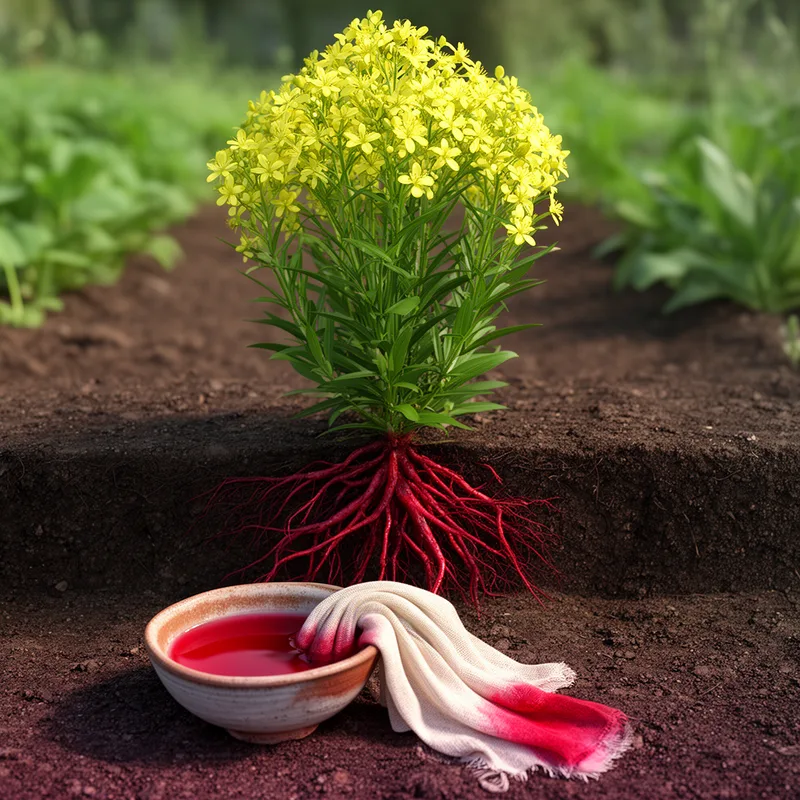
Rubia tinctorum
- noun
- Specialized
- Botanists study Rubia tinctorum to understand traditional sources of pigments.
Examples
-
The roots of Rubia tinctorum have been used in textile dyeing for centuries.
-
Rubia tinctorum was once widely cultivated in Europe for its red dye.
-
The Rubia tinctorum plant is known for its vibrant red dye.
-
Farmers used to cultivate Rubia tinctorum extensively.
-
The red dye was traditionally extracted from the roots of Rubia tinctorum, also known as madder.
-
Farmers used Rubia tinctorum for centuries to produce a vibrant red color for their textiles.
-
In ancient times, artisans cultivated Rubia tinctorum to create the dye alizarin for fabric coloring.
Synonyms

 7
9.9
7
9.9

A plant from Europe and Asia with red roots used to make red dye
Surface Forms
Morphology
Rubia + tinctorum
This is a Latin taxonomic name, not a regular English compositional phrase; even if a learner knows that Rubia is a genus of dye-producing plants, the species epithet 'tinctorum' is not an English word and is unlikely to be meaningful to a B1 learner. The overall referent (a specific dye-producing plant) therefore cannot be reliably derived from the constituent words by an average B1 learner without specialist or Latin-root knowledge.
Etymology
Rubia tinctorum comes from old Latin words: Rubia from the word 'red' and tinctorum meaning 'for dyeing'. That's why the name refers to a plant people used to make red dye.