

Rubia cordifolia
- noun
- Specialized
- For centuries, Rubia cordifolia roots have been used to produce a deep red textile dye.
Examples
-
Many artisans use Rubia cordifolia to dye fabrics.
-
Dye extracted from Rubia cordifolia was highly valued in ancient Asian cultures.
-
The herbalist recommended Rubia cordifolia for its traditional medicinal properties in Ayurveda.
-
The Rubia cordifolia plant is known for its vibrant red dye.
-
Dye extracted from Rubia cordifolia was highly valued in ancient Asian cultures.
-
For centuries, Rubia cordifolia roots have been used to produce a deep red textile dye.
-
Many artisans use Rubia cordifolia to dye fabrics.
Synonyms
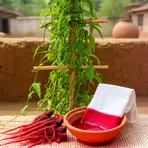
A climbing plant from India whose roots make red dye
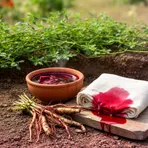
A creeping plant whose roots make red dye for cloth
Surface Forms
Morphology
Rubia + cordifolia
This is a Latin taxonomic binomial combining the genus name 'Rubia' (a plant genus often associated with dye-producing species) with a specific epithet 'cordifolia' (literally ‘heart‑leaved’), so a learner who knows both constituents could infer it denotes a Rubia species with heart‑shaped leaves — i.e., a plant. However, details like perennial/climbing habit and especially its traditional use for red dye are not fully predictable from the parts alone, and the epithet is not a common English word, so comprehension is only partial.
Etymology
Rubia cordifolia is a scientific name from Latin: rubia means 'red' and cordifolia means 'heart-shaped leaves'. That's why the name paints a clear picture — the plant has heart-like leaves and its roots were used to make a deep red dye.

