
Rosicrucianism


 1
9.9
- noun
- /ˌroʊzɪˈkruːʃənɪzəm/
- The principles of Rosicrucianism emphasize the importance of personal spiritual transformation and knowledge.
- Rosicrucianism and Freemasonry
Loading YouTube…
Watch on YouTubeAnd so our esoteric name in Rosicrucianism is spirits of love and freedom.
- And so our esoteric name in Rosicrucianism is spirits of love and freedom.
- And yeah, next thing you know, I'm studying like Hermeticism and Gnosticism and Rosicrucianism and the wisdom traditions and things like that.
Examples
-
In the 17th century, Rosicrucianism emerged as a secret society focused on mysticism and the pursuit of enlightenment.
-
Using the Kabalistic technique of combining numbers (a practice common in Freemasonry and Rosicrucianism), Father Espinoza's age (45) becomes 4 + 5, or 9; the process of confession begins at nine in the morning (HR 9); and the hour at which the man of the rose begins his demonstration is 3:30 p.m. (3 x 3).
Academic text (2000) -
And so our esoteric name in Rosicrucianism is spirits of love and freedom.
-
By the early modern period, Rosicrucianism and Freemasonry mingled in the mix.
Academic text (2010) -
Germany had a strong heritage in occultism: it was the original home of Rosicrucianism, and related movements like Freemasonry were popular.
Academic text (1993) -
Leonardo da Vinci was a Rosicrucian, but the term Rosicrucianism comes from the term Rose Cross.
-
My father saw more than I; he's studied different philosophies as well as Rosicrucianism and Hermeticism.
Blog text (30) -
And yeah, next thing you know, I'm studying like Hermeticism and Gnosticism and Rosicrucianism and the wisdom traditions and things like that.
-
This turn-of-the-century organization was founded by people involved in both Theosophy and Rosicrucianism, including the poet W.B. Yeats.
Academic text (1993) -
Rojas thus reconfirms a lifestyle that permits a person the freedom to contemplate the truly important questions embodied in the rose-mandala of Freemasonry and Rosicrucianism.
Academic text (2000)
Surface Forms
Morphology
Rosicrucianism = Rosicrucian (opaque) = Rosicrucian + ism
The suffix '-ism' regularly forms a doctrine or movement from a base name, but the base 'Rosicrucian' is an obscure historical proper name.
Etymology
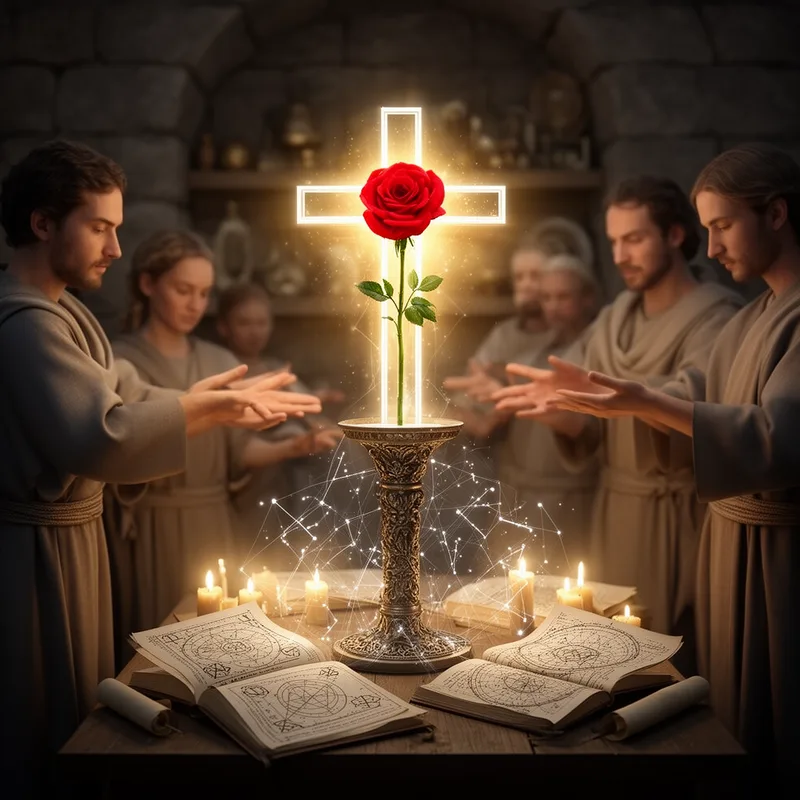
Rosicrucianism comes from the Latin words rosa 'rose' and crux 'cross', so it literally names a belief or group tied to the rose and the cross. That's why the movement uses the rose-and-cross symbol and teaches about resurrection and secret or mystical knowledge.