

Rorippa islandica
- noun
- Specialized
- Early settlers used Rorippa islandica as a leafy vegetable in soups and salads.
Examples
-
Rorippa islandica often thrives along riverbanks and wet meadows during the summer months.
-
Some gardeners remove Rorippa islandica because it can become invasive in moist soil.
-
The Rorippa islandica thrives in wetland areas.
-
Have you ever tried Rorippa islandica in a salad?
-
Many people enjoy adding Rorippa islandica to their salads for its peppery flavor.
-
In many regions, Rorippa islandica is considered a weed, often growing in unwanted areas.
-
Farmers sometimes cultivate Rorippa islandica for its edible leaves, especially in damp fields.
Synonyms
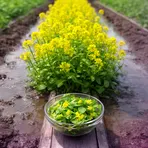
A plant with yellow flowers that grows in wet places and people use in salads or see as a weed

A plant that grows in wet places and is eaten in salads and sometimes removed as a weed
Surface Forms
Morphology
Rorippa + islandica
This is a scientific binomial (genus + specific epithet): 'Rorippa' names a group of herbaceous plants and 'islandica' transparently suggests an origin/association with islands or Iceland. A learner who knows those constituents could infer it is a particular Rorippa species, but the precise botanical/culinary senses (annual/biennial cress, edible/weed) and the Latin naming convention require specialist knowledge, so the meaning is only partially predictable to a B1 learner.
Etymology
Rorippa islandica may come from a word for 'dew' or wetness, and the name part islandica means 'from islands' like Iceland. This simple image, a small cress growing in wet, island places, helps explain why the plant lives by rivers and in wet meadows and is used as a leafy vegetable.

