

Roman nose
 1
7.5
1
7.5

- noun
- /ˈroʊmən noʊz/
- Red sweetened hair, soft Roman nose.
- eyes and a Roman nose
- a straight Roman nose
- Roman nose and massive forehead
Examples
-
Many people admire his Roman nose as a distinctive feature of his appearance.
-
And he is handsome; he has a Roman nose.
Fiction book (1997) -
She told the proprietor, an elegant young woman with dark hair and eyes and a Roman nose, that she herself was in the business.
Fiction book (1998) -
Beau had inherited his father's Roman nose and sharp jawline.
Fiction book (1995) -
She had fine, chiseled features, a Roman nose, and high cheekbones.
Fiction book (2000) -
His handsome face was so familiar to me: his sensual and perfect mouth, his perfectly straight Roman nose, and his strong, chiseled-looking chin.
Fiction book (1995) -
I saw the straight, scarcely noticeable Roman nose, the small pink mouth opening slightly in a smile, and her big eyes of an almost amber color, like two suns.
Fiction book (2001) -
Bell wears his hair in a sleek silver bob and has a strong Roman nose, but his extremely lean physique is evidence of a long-distance running habit, not some otherworldly hunger.
Blog text (1) -
She loved how the Roman nose of the statue captured the beauty of ancient art.
-
His Roman nose reminded her of classical sculptures she had studied in art history.
Synonyms
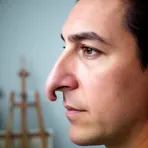
A long nose that curves down near the tip
How Prominent

Surface Forms
Morphology
The meaning 'a nose with a prominent, slightly curved bridge' is directly derivable from combining 'Roman' (pertaining to Rome/ancient Romans) with 'nose' — it names a nose type resembling profiles seen in Roman statuary. This compositional, descriptive pattern is culturally motivated but predictable, so a B1 learner who knows both constituents can infer the intended sense.
Etymology
Roman nose comes from old statues and pictures of people from Rome, where the nose looks strong and slightly curved. Because of that picture, today Roman nose means 'a nose with a high, slightly curved bridge'.