
Robinson Crusoe
 4
5.5

- proper noun
- /ˈrɑbɪnsən ˈkruːsoʊ/
- Literature
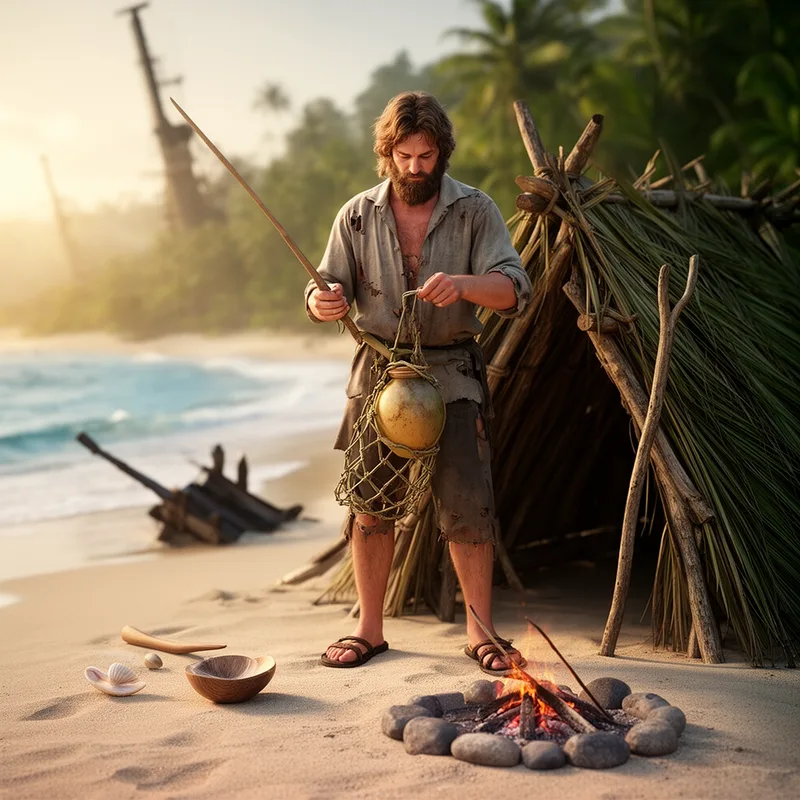
- Robinson Crusoe demonstrates incredible resourcefulness as he learns to build shelter and find food.
- Defoe's Robinson Crusoe
Examples
-
Books like Robinson Crusoe didn't contain maps.
Academic text (2014) -
Tim Severin's book, Seeking Robinson Crusoe, is a recent backgrounder on this.
Blog text (29) -
" The tale of Robinson Crusoe strikes a responsive chord in the imagination of many economists.
Blog text (29) -
Is it Cruso speaking here, or is it the soon-to-be Robinson Crusoe of Defoe's novel?
Academic text (2017) -
Borrowing from Defoe's Robinson Crusoe, Cooper assigned Bumppo an Indian companion, Chingachgook.
Academic text (2014) -
Like Defoe's Robinson Crusoe, Boone, along with his exploits, should be viewed in the context of colonial discourse.
Academic text (2014) -
In Daniel Defoe's novel, Robinson Crusoe is a sailor who survives for years on a deserted island.
-
Many people find inspiration in the story of Robinson Crusoe and his adventures in isolation.
Surface Forms
Morphology
Robinson + Crusoe
This is a proper name made of two personal names that have no independent lexical meanings a learner can compose; knowing the constituents 'Robinson' and 'Crusoe' does not let one infer the character, story, or traits. The expression is referential and culturally specific (requires literary/cultural knowledge), so its meaning is not derivable from the parts.
Etymology
Robinson Crusoe is the name of a shipwrecked sailor in Daniel Defoe's story who lived alone on a deserted island and had to make shelter, find food and clever tools to stay alive. Because of that clear image of living alone and solving problems, the name now describes someone who is alone and 'resourceful'.